Label: Analysis.
The $8 billion farmers were promised on Sunday is real money on paper, but no farmer knows yet what they will get. USDA says the Harvest Fuel Relief payments will be one-time, calculated from planted acres, and paid under the Commodity Credit Corporation Charter Act rather than a new appropriation from Congress. The per-crop rates for major commodities will not be published until November. Everyone else, from specialty growers to fishermen, is told to email the department their fuel costs and wait. [1]
The number
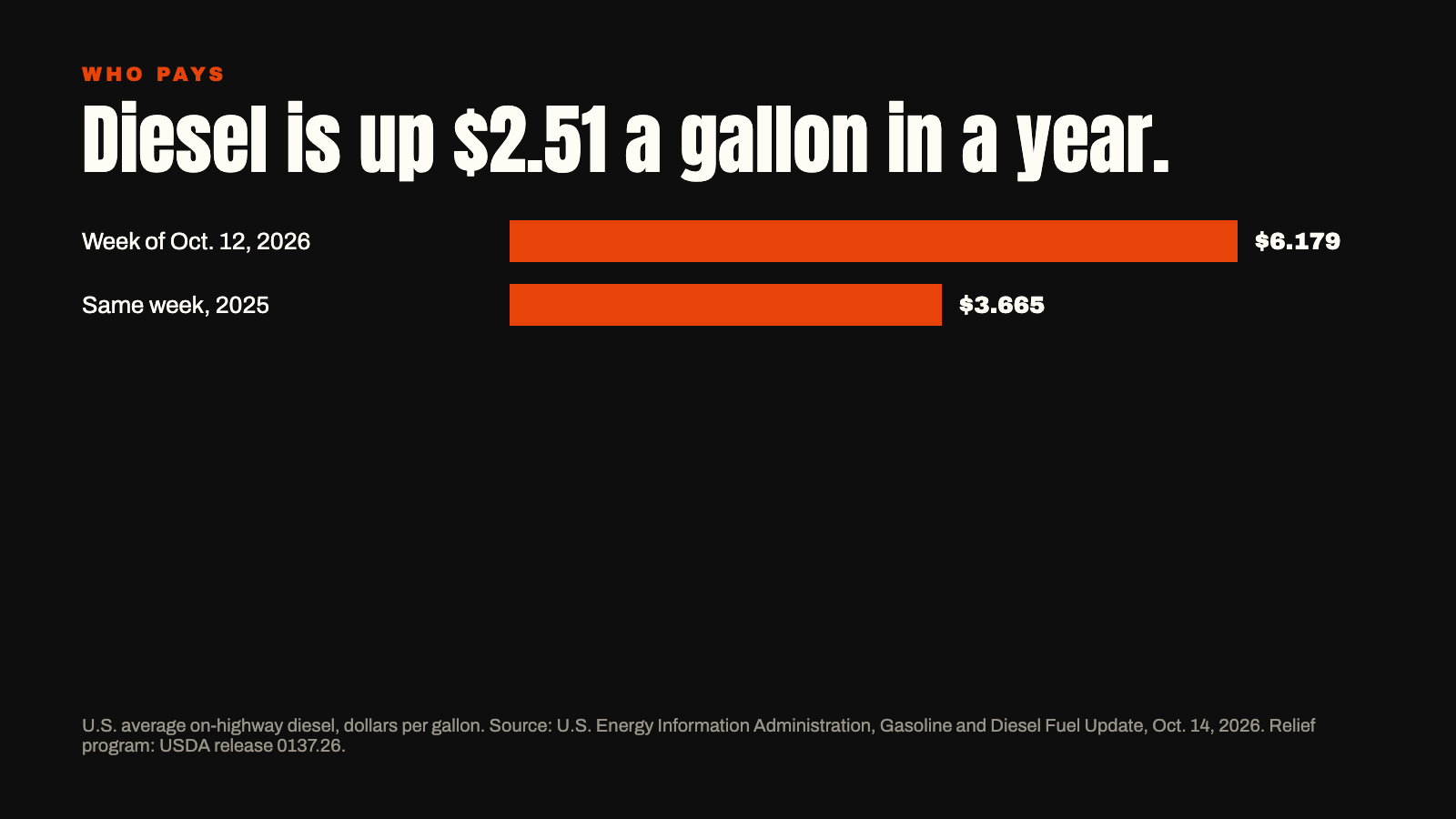
USDA will “make $8 billion available for one-time payments to American farmers this harvest season,” according to the department’s release. [1] The pressure behind it is in the federal fuel data. In the week of October 12, the U.S. average on-highway diesel price was $6.179 a gallon, up $2.514 from a year earlier. In the Midwest it was $6.259, up $2.653. [2]
That is the cost a combine, a grain truck and a dryer run on. The relief is meant to cover “a portion of modeled losses during the 2026 crop year,” not a farmer’s actual fuel bill. [1]
Who decided
The President and Agriculture Secretary Brooke Rollins announced it. Congress did not vote on it. The release says the payments are “authorized under the Commodity Credit Corporation (CCC) Charter Act” and will be run by the Farm Service Agency. [1] That is the same lever the administration used for the Farmer Bridge Assistance program, which the release says paid $12 billion to more than 560,000 farmers earlier this year. [1]
Using the CCC means speed. It also means the size, the formula and the timing were set inside one department, weeks before an election, without a single recorded vote.
Who gets paid, and how much
The formula is a “national loss average” built from three federal data sets: acres farmers reported planting to FSA, the Economic Research Service’s cost-of-production estimates, and the World Agricultural Supply and Demand Estimates for yields and prices. [1] Because the payment is tied to planted acres, the operations with the most acres stand to collect the most. A uniform formula is simple. It is not targeted to the farmer whose margins are thinnest.
Crop insurance enrollment is not required to qualify. [1] Commodity-specific payment rates for Title I crops, the program crops like corn, soybeans and wheat, come in November. Methodology for every other eligible commodity will be “announced at a later date.” [1] Specialty crop growers and fishermen are asked to send fuel cost data to a USDA inbox “for USDA’s consideration.” [1]
Who pays
Taxpayers, through the CCC. The release frames the program as building on “unprecedented support,” noting nearly $14 billion in gross ARC and PLC payments two weeks ago. [1] Add the $12 billion bridge program and this $8 billion, and the three programs named in USDA’s release come to about $34 billion. [1] None of it lowers the price of a gallon of diesel. It hands back part of the cost after the fact, on a schedule the department controls.
What to watch
The November rate sheet is the real announcement. Until USDA publishes dollars per acre for each crop, the $8 billion is a headline, not a check. Watch who gets a rate in November and who is still waiting on “a later date.”