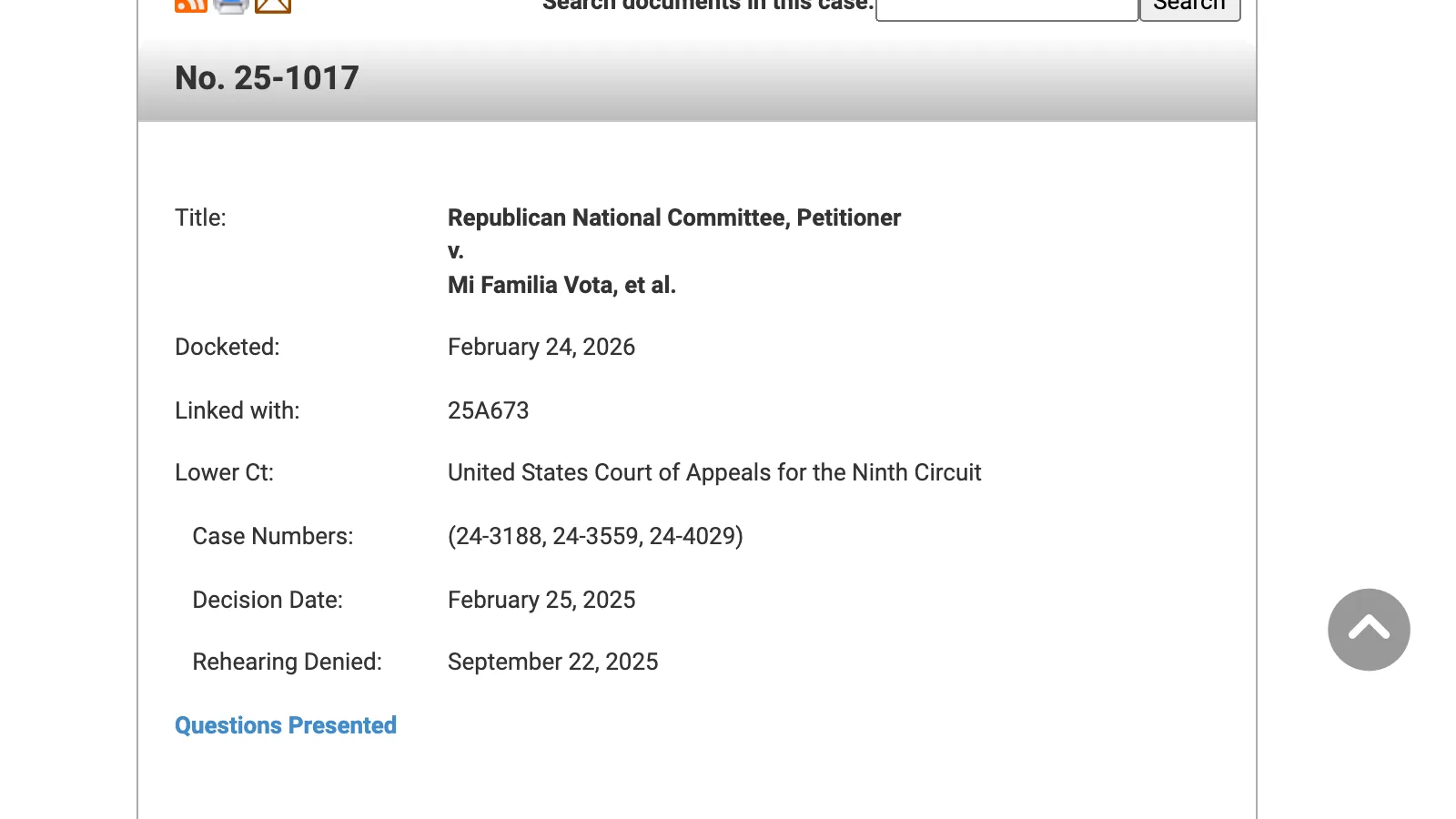
Can a state make you prove you are a citizen, with documents, before it lets you register to vote? The Supreme Court will hear that question on Tuesday, Dec. 8, in Republican National Committee v. Mi Familia Vota, No. 25-1017. It agreed to take the case on June 29. It has not ruled.
The two questions. The Court’s own wording asks, first, whether federal voter-registration law or a court settlement stops Arizona from requiring “satisfactory evidence” of citizenship from people registering on the state’s form. Second, whether that same law stops Arizona from running a program to cancel the registrations of noncitizens within 90 days of a federal election.
How it got here. Arizona passed both rules in 2022. The Ninth Circuit Court of Appeals ruled in February 2025 that they violate the National Voter Registration Act. The Supreme Court had already let the proof-of-citizenship requirement stay in effect in August 2024 while the fight went on.
If the RNC wins on the first question, Arizona can require documentary proof of citizenship from anyone registering on the state form, and other states will point to the ruling to pass the same rule. The people hit hardest are citizens who do not have those papers handy.
If Mi Familia Vota wins, the appeals court ruling stands, and Arizona cannot demand documents on its state form.
On the second question, a win for the RNC lets Arizona cancel registrations it flags as noncitizens inside the final 90 days before a federal election. A loss means that program has to stop during the 90-day period.
Whatever the justices decide will not touch the Nov. 3 midterms. It will set the rules for elections after the Court rules. Watch the argument on Dec. 8.