Too Big To Rig
The 2026 fight is not just persuasion. It is turnout, cure, rides, watchers, primary intervention, local reporting, and margins big enough to make the machine choke on its own paperwork.
They can redraw the map, shrink the notice, sue after voters speak, and call confusion a strategy. The answer is not panic. The answer is margin.
“Close is where they work. Margin is how we make them fail.”
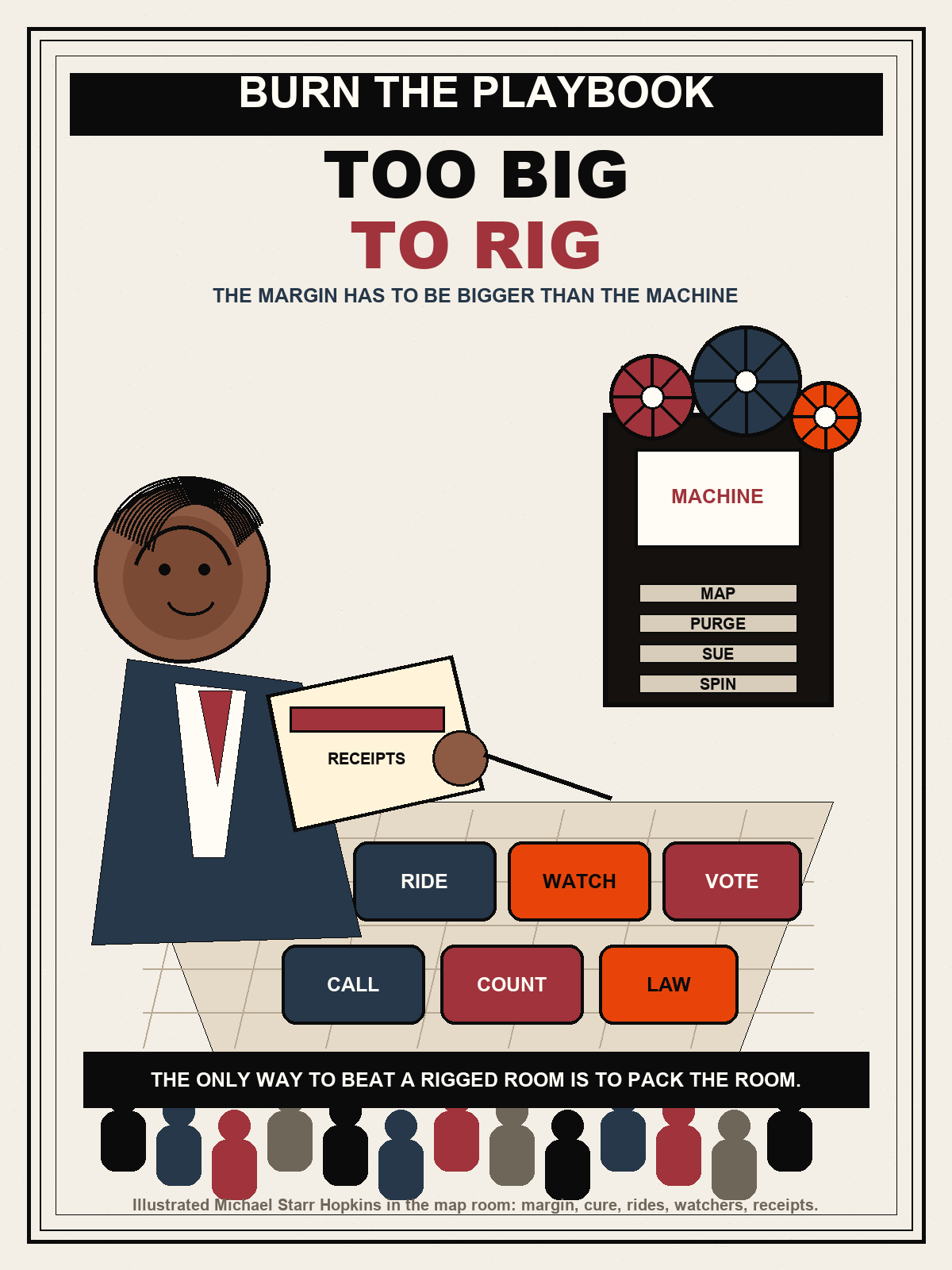
The full report is below, archived here with the public receipt trail, source ladder, and reader actions intact. Every claim below clears at two-of-three independent sources before publication, with right-of-reply offered to every named subject.
| Strategy Field Manual | Saturday, May 9, 2026 |
BTP Original · Issue 030 · 2026
BURN THE PLAYBOOK
May The Bridges We Burn Light Our Path Forward.
Map war. Primary rules. Ballot cure. Local reporting. Margin.
The Only 2026 Strategy That Survives The Map War
Too Big To Rig
The 2026 fight is not just persuasion. It is turnout, cure, rides, watchers, primary intervention, local reporting, and margins big enough to make the machine choke on its own paperwork.
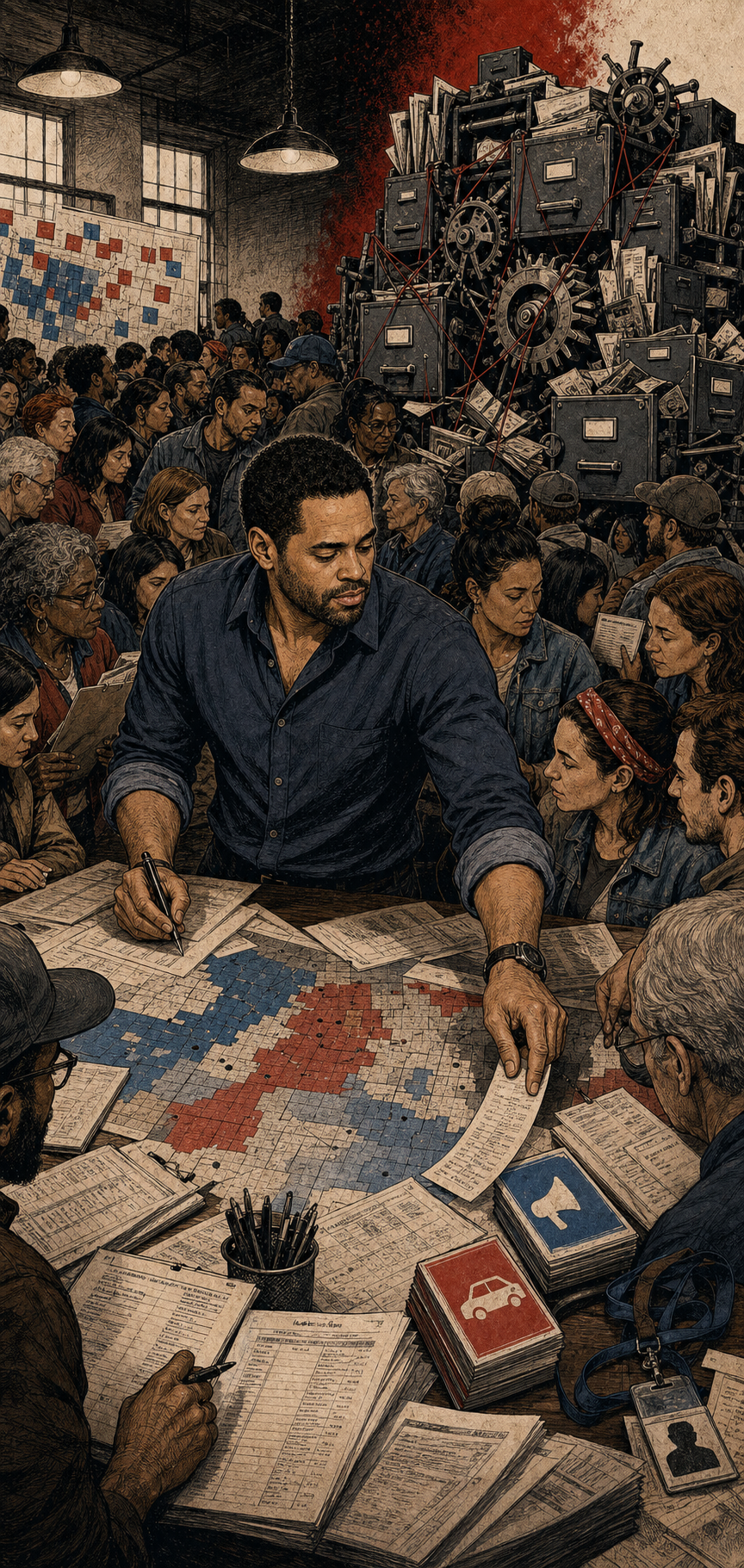
I spent years in rooms where campaigns treated voter protection like insurance.
Buy it late.
Talk about it quietly.
Hope you never need it.
That thinking is dead.
The 2026 election will not be won by the campaign that has the cleanest slogan about democracy. It will be won by the campaign, party, organizer, church, union, neighborhood group, lawsuit, rides program, ballot-cure desk, poll-watcher team, local reporter, and exhausted county volunteer that understands the same hard thing at the same time:
Close is where they work.
Close is where they sue.
Close is where they purge, delay, confuse, threaten, split, recount, reject, and spin.
The strategy is too big to rig.
The only way to beat a rigged room is to pack the room.
A Personal Note
I do not want us walking into 2026 like normal.
Normal is how we got here.
Normal is waiting for a candidate to inspire us, waiting for a party committee to save us, waiting for a court to rescue us, waiting for a poll to tell us whether the country is worth fighting for.
I am done waiting.
We have to get more creative about democracy than the people trying to shrink it.
That does not mean reckless. It does not mean illegal. It does not mean lying on a form, signing an oath you do not mean, or turning politics into a stunt. It means looking at the actual rules in the actual state where we live and asking a grown-up question:
Where is power really being chosen?
If the answer is the general election, organize there.
If the answer is the Republican primary in a state where Republicans hold a supermajority, then we need to stop acting like that primary is somebody else's private appointment calendar. If the law lets you vote there, and that is where the sheriff, prosecutor, legislator, county commissioner, election official, or member of Congress is effectively chosen, then that is politics working exactly where it is happening.
We have spent too many years treating politics like a brand preference.
Politics is not a bumper sticker.
Politics is who gets the road fixed. Who counts the ballot. Who prosecutes the case. Who draws the district. Who chooses the textbooks. Who staffs the polling place. Who decides whether your grandmother gets a notice when her precinct changes.
So yes, we need better candidates.
But we also need better habits.
We need people checking their registration before the panic. We need people learning primary rules before the deadline. We need people subscribing to local reporters before the crisis. We need people volunteering as poll workers, driving neighbors, curing ballots, watching county boards, reading court orders, and refusing to let democracy become a thing we only discuss after someone else breaks it.
The other side has been creative about power for years.
They used school boards. They used primaries. They used statehouses. They used courts. They used ballot language. They used county meetings nobody watched. They used boring process because boring process moves real power.
Fine.
Then we get creative too.
Not by becoming cynical.
By becoming useful.
By making our politics work for us again.
That is what "too big to rig" means to me. It is not a fantasy that the machine disappears. It is a decision to build something bigger than the machine can quietly contain.
Why Now
Because the map war stopped being a theory.
On April 29, 2026, the Supreme Court decided Louisiana v. Callais. The Court said the Voting Rights Act did not require Louisiana to create an additional majority-minority district, and the opinion narrowed the path for Section 2 claims that had protected voters of color from racial vote dilution. The Brennan Center put the consequence plainly: the ruling substantially rewrote Section 2 and undermined long-standing protections against racial discrimination.
Then Tennessee moved.
WPLN's Marianna Bacallao and Tony Gonzalez reported that Tennessee's GOP-led statehouse voted to carve Memphis into three reliably red districts after President Trump called for more Republican seats in Congress. The NAACP quickly filed a legal challenge. Pearson called the maps racist tools of white supremacy. Sen. London Lamar said you cannot fracture a majority-Black city and pretend race has nothing to do with it.
WPLN also reported that the proposed map split Memphis into three districts, fractured Nashville and surrounding counties into five, and could produce a 9-0 Republican congressional delegation in a state where roughly a third of voters backed Democrats in the last two presidential elections.
That is not housekeeping.
That is a confession.
Alabama moved too. WBHM's Andrew Gelderman reported from Montgomery as protesters gathered outside a special session called after Callais. The fight centers on a 2023 map that federal courts said violated the Voting Rights Act by diluting Black voters' influence. A court-drawn map helped elect two Black Democrats in 2024. Alabama officials want the Supreme Court to let the old map stand.
Virginia became the other side of the same lesson. VPM's Jahd Khalil tracked the legal fight after Virginians voted on a redistricting amendment. Then Axios Richmond reported that the Virginia Supreme Court threw out the referendum results.
They can narrow the Voting Rights Act. They can redraw the districts. They can change notice rules. They can reopen qualifying windows. They can suspend or scramble primaries. They can sue after voters speak. They can call the whole thing procedure and dare normal people to stay awake.
That is why the answer has to be bigger than a press release.
Watch Pearson First
If there is one clip that earns space in this issue, it is Justin J. Pearson in Memphis explaining the redistricting fight in plain moral language.
If your inbox strips the video, watch Pearson here.
If the embed does not carry cleanly, use the WSMV local video showing Pearson and protesters yelling "shame" after Tennessee lawmakers passed the map.
Then listen local. The Daily Memphian's AM/DM podcast had Mary Cashiola and Bill Dries walking through District 9, primary voting, and the special session before the vote. NashVillager's episode on "Redistricting the site of the Memphis Massacre" is the kind of local frame national politics usually steals without credit.
The people closest to the wound usually explain the wound best.
The Machine
The machine has five moves.
01. Shrink the battlefield.
Fewer competitive districts. More voters packed into places where their votes pile up without power. More cities split into fragments. More safe seats where the real election happens in the primary and the general election becomes civic theater. Axios reported just 16 of 435 House races were rated Toss Up by Cook Political Report after the redistricting war accelerated.
02. Change the rules late.
WPLN reported Tennessee lawmakers also dropped a requirement that voters receive mail notice if their polling place changes because of redrawn maps. Local governments can post to a public website instead. That sounds boring until somebody's grandmother shows up at the wrong place.
03. Use confusion as suppression.
If voters do not know their district, polling place, primary deadline, candidate list, ballot status, cure process, or ID rule, the machine does not have to defeat them. It only has to exhaust them.
04. Litigate the calendar.
Virginia voters approved a redistricting referendum. Then the court fight swallowed it. Louisiana's House primaries were thrown into confusion after Callais. Alabama is preparing contingency primaries in case the courts move fast enough. Tennessee lawsuits landed immediately after the new map became law.
05. Flood the zone with fear.
In 2024, the FBI said bomb threats to polling locations in several states appeared to originate from Russian email domains and were not credible. The point of a fake threat is not always to close the polls for good. Sometimes the point is to make voting feel unstable, dangerous, and suspicious.
That is why "too big to rig" cannot just mean more TV ads. It means the civic system has to be stronger than the pressure campaign.
The Receipt
The receipt is not one filing. It is the pattern.
Brennan's 2025 voting-laws review found at least 16 states enacted 31 restrictive laws in 2025, with 30 fully in effect for the 2026 midterms and parts of the 31st in effect too. It also found at least seven states enacted eight election-interference laws in 2025, all in effect for the midterms.
The EAC says 44 percent of states have either open partisan primaries or primaries open to unaffiliated voters, while 20 percent of states plus D.C. have closed partisan primaries.
NCSL shows why the primary question matters. Alabama, Georgia, Mississippi, South Carolina, Texas, Virginia, and Wisconsin are among open primary states. Other states have partially open or partially closed systems. Some states have closed primaries. Tennessee is listed in the closed-primary category, and Tennessee voters face bona fide party-member or allegiance language.
That means the strategy has to be legal, local, and specific.
No folk wisdom.
No "just show up and ask for the other ballot" advice without checking the rules.
No signing party statements falsely.
The machine lives in details. So does the answer.
The Strategy
Too big to rig has ten jobs.
- Stop aiming for close. Every target race needs the number required to win and the number required to make manipulation expensive, obvious, and unlikely to survive public scrutiny.
- Bank the vote before the machine wakes up. Election Day is not a day anymore. It is the last day. Bank votes early. Cure them daily. Chase every ballot until it is accepted or replaced.
- Build a ballot-cure army. Ballot cure is rescue: names, numbers, deadlines, scripts, transportation, translators, lawyers, and volunteers who can explain the fix without making voters feel stupid.
- Make local reporting part of the field plan. If a local reporter writes that a polling-place notice requirement changed, that is not content. That is a field assignment.
- Vote where power is actually chosen. In open-primary states where the Republican primary effectively chooses the sheriff, prosecutor, county commissioner, state legislator, election official, or member of Congress, sitting out is not moral purity. It is surrender.
- Stop letting county government be invisible. Election sabotage starts with boards, administrators, secretaries of state, county commissions, sheriffs, judges, clerks, school boards, and legislators nobody can name until they break something.
- Put a lawyer next to a pastor and a mechanic. The lawyer knows the deadline. The pastor knows who needs a ride. The mechanic knows whose car will not start. The campaign that connects those people beats another Zoom about messaging.
- Build the receipts before the theft. Track precinct changes, mail notices, voter-file cancellations, poll-worker shortages, machine issues, language-access problems, long lines, ballot rejection patterns, provisional ballot reasons, intimidation reports, public-meeting notices, and emergency court filings.
- Say one sentence until it becomes the public's sentence. They made your vote smaller. We make turnout bigger.
- Make the cost of manipulation public. If a map changes, show the old district and the new district. If a polling-place notice rule changes, show the voter who will not get the letter. If a ballot is rejected, show the fix.
The slogan is not "win." The slogan is "win past the margin of theft."
The Primary Rule
This deserves its own box because it is the part people will pretend not to understand.
In a one-party state, the dominant-party primary often functions as the real general election.
That means pro-democracy voters need a primary plan.
Open-primary states: If the Republican primary chooses the sheriff, school board majority, prosecutor, county commissioner, or state legislator who will govern everybody, then everybody affected by that office has an interest in the outcome.
Partially open or partially closed states: Unaffiliated voters may have options that registered partisans do not. Learn them early.
Closed-primary states: Do not freelance. Learn the registration deadline, affiliation rule, oath language, and legal risk. If the rules say no, the answer is not to lie. The answer is to organize where the law allows.
This is not about Democrats becoming Republicans.
This is about citizens refusing to let a supermajority choose the government in a room they were legally allowed to enter but politically trained to avoid.
The Field Plan
Here is the 2026 checklist:
- Identify every county where the Republican primary is the real election.
- Publish plain-language primary rules by state and county, with links to official election offices.
- Build a "where power is chosen" voter guide for sheriffs, prosecutors, election boards, state legislatures, judges, and county commissions.
- Recruit poll workers in target counties before the panic.
- Build a ballot-cure team before the first mail ballots go out.
- Create a local-reporting watch list and subscribe to the outlets doing the work.
- Fund rides to vote like they are persuasion ads, because they are.
- Track every polling-place change and turn it into a neighborhood alert.
- Put voter-protection lawyers in the room before the emergency, not after.
- Make every candidate answer one question: how many votes are you trying to win by beyond the recount margin?
The campaigns that can answer that question are serious.
The campaigns that cannot are selling hope as logistics.
The Local Reporting To Send
Send these before you send a think piece:
- WPLN: Tennessee approves Trump redistricting plan, dividing majority-Black Memphis voting bloc
- WPLN: Tennessee GOP unveils new maps fracturing Memphis and Nashville area
- Daily Memphian AM/DM: The future of District 9, plus primary voting
- WSMV: Pearson and protesters yell "shame" after map passage
- WBHM: Alabama protesters say every vote matters
- Alabama Reflector: special session on court-altered districts
- VPM: Virginia Supreme Court arguments over redistricting vote
- Axios Richmond: Virginia court throws out redistricting referendum results
- GPB: Georgia will not redraw in 2026, but Callais sets up 2028
- Texas Tribune / Votebeat: Callais could reshape local boards and councils
Local reporting is not garnish. It is the smoke alarm.
Friendly Fire
Democrats cannot keep treating voter protection like a lawyerly afterthought and then act shocked when Republicans treat election administration like a power center.
Stop saying "organize" when you mean "fundraise."
Stop saying "protect democracy" when you have not recruited poll workers.
Stop saying "Black voters are the base" while learning about majority-Black districts only after the map is cut.
Stop saying "young people do not vote" while making voting feel like a scavenger hunt designed by a hostile county clerk.
Stop saying "rural voters are gone" while refusing to show up in the dominant-party primary that chooses their sheriff.
Stop saying "the courts will save us."
The courts are one battlefield. They are not a strategy.
The Verdict
Too big to rig is not a slogan about fraud.
It is a strategy against fragility.
It says the vote margin must be bigger than the legal margin. The voter-contact program must be bigger than the confusion program. The local reporting must be faster than the national panic. The primary plan must go where power is actually chosen. The cure operation must be ready before the rejection notice. The rides program must start before Election Day becomes an emergency. The receipts must exist before the lie.
The machine wants a close election and a tired public.
Give it neither.
Make the election too big to steal, too organized to suppress, too watched to spin, and too local to ignore.
May the bridges we burn light our paths forward.
Send The Field Plan
Send this to the person who still thinks the only election that matters is November. Then send them their state's primary rules.
Core Sources
Supreme Court: Louisiana v. Callais · Brennan on Callais · Brennan voting-law roundup · EAC primary election types · NCSL primary systems · FEC 2024 official presidential results · FBI 2024 bomb-threat statement
May The Bridges We Burn Light Our Path Forward.
Michael Starr Hopkins · Burn The Playbook · Est. 2026
All burns original. Every name sourced. Every comfortable version killed.
This one is built to forward.
Drop your email and the next receipt lands where you can actually use it.
Receipts in this issue
Already on the list? Send this to one person who reads the fine print.
New here? Subscribe from this issue so the dashboard can count the public funnel, not just imports.