Twenty-Four to Four
Florida did not win the argument. It changed the shape of the electorate.
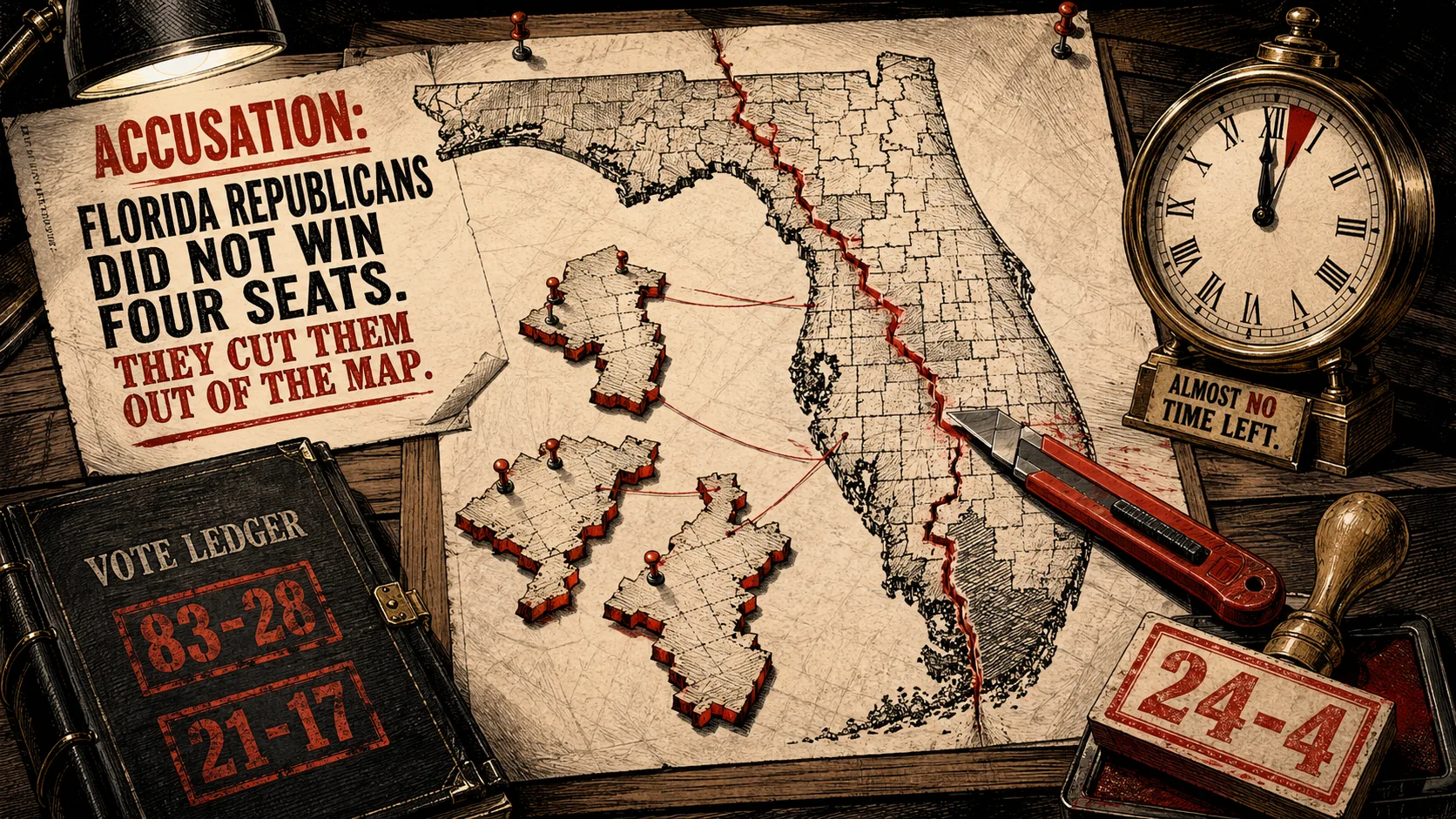
Twenty-Four to Four
Florida did not win the argument.
It changed the electorate.
That is the cleanest way to say what happened in Tallahassee this week. Do not let anyone dress it up as a court story. Do not let anyone bury it under “race-neutral” language. Do not let anyone pretend the machinery moved slowly because government is complicated. It did not move slowly. It moved like a blade.
On Monday, April 27, 2026, Gov. Ron DeSantis sent lawmakers a new congressional map. The Florida Senate’s own redistricting page says the Executive Office of the Governor transmitted the plan for Special Session D. The attached letter urged the Legislature to adopt it during a special session scheduled to begin the next day. The Senate packet says President Don Gaetz received the map at 11:15 a.m. Monday and was filing it as SB 8-D for consideration. The final vehicle was HB 1-D, sponsored by Rep. Jenna Persons-Mulicka, which the Senate substituted for SB 8-D on April 29.
By Wednesday, April 29, the Legislature was done.
AP, published by Local10, reported the Florida House passed the map 83-28. The Florida Senate followed 21-17. The same report put the core number on the table: DeSantis’ map could move Florida’s House delegation from a 20-8 Republican advantage to 24-4.
Twenty-four to four.
Not because Florida held an election.
Not because four Democratic incumbents lost their districts in front of voters.
Not because an argument was made and won in public.
Because a new electorate was drawn around the old one.
This is the part Democrats have to stop treating like civics homework. A gerrymander is not a diagram. It is a personnel decision. It decides which voters get to matter together and which voters get scattered until their power looks like noise. It decides whether a city speaks with one voice or gets sliced into pieces small enough to ignore. It decides whether a county can make one demand or has to beg three different representatives to remember it exists.
The map did not only change lines. It changed accountability.
Look at the local consequences inside the Florida Senate’s own data packet.
Tampa is not just Tampa anymore. The packet places 121,400 Tampa residents in District 12, 138,303 in District 14, and 125,256 in District 15. That is one city turned into three congressional conversations.
St. Petersburg is split too: 88,616 residents in District 13, 169,692 in District 16. Pinellas is carved into Districts 13 and 16. Hillsborough is carved into Districts 12, 14, and 15. Pasco is carved into Districts 12, 13, and 15. Sarasota is carved into Districts 16 and 17.
In South Florida, the same knife keeps moving.
Fort Lauderdale is divided between District 20 and District 25. Miami is divided between District 24 and District 27. Hollywood is divided among Districts 24, 25, and 26. Miramar is divided between Districts 24 and 26. Pembroke Pines is divided between Districts 24 and 26. North Miami is divided between Districts 24 and 25. North Miami Beach is divided between Districts 24 and 25. Delray Beach is divided between Districts 23 and 25. West Palm Beach is divided between Districts 21 and 23.
These are not legal abstractions. These are field universes. These are churches, campuses, condo towers, union locals, precinct captains, city commissioners, radio markets, school-board fights, and neighborhood associations that would be reassigned under a map drawn by people who know exactly what a map can do.
AP/Local10 reported the new map reshapes Democratic areas around Orlando, Tampa-St. Petersburg, Palm Beach, Fort Lauderdale, and Miami. It reported the changes could cost Jared Moskowitz and Debbie Wasserman Schultz, among others, their seats. It also reported the effective elimination of one nearly majority Black South Florida district represented by Sheila Cherfilus-McCormick until her resignation earlier this month.
That is not a footnote. That is the political theory.
When you hear “24-4,” do not hear math. Hear erasure with a spreadsheet.
The public version is that Florida needed a new map because of population growth, because of the Supreme Court, because the legal landscape changed, because old racial protections were vulnerable, because the state needed a “race-neutral” congressional plan. That is the story Florida Republicans want reporters to cover. It sounds technical. It sounds inevitable. It sounds like a court made them do it.
But the process tells on itself.
The Governor’s office sent the map on April 27. The special session began April 28. The Legislature approved the plan April 29. AP/Local10 reported that Republicans said little about the proposed districts during the session. The House sponsor, Rep. Jenna Persons-Mulicka, gave careful answers about an “evolving legal landscape.” When asked about the map drawer’s admission that he looked at party affiliation and voting patterns, AP/Local10 reported she said she could not speak to the intent of the map drawer.
That is the sentence every Florida Democrat should repeat until it sticks.
She could not speak to the intent of the map drawer.
Then she voted for the map.
That is not a small contradiction. That is the whole prosecution.
If a city council member said they could not speak to the intent of the consultant who designed a zoning map, then voted to move a neighborhood anyway, the neighborhood would know what happened. If a school board member said they could not speak to the intent of the person who redrew attendance zones, then voted to move students anyway, parents would know what happened. If a county commissioner said they could not speak to the intent of the person who moved a polling place, then voted to move it anyway, nobody would need a constitutional law seminar to understand the problem.
But redistricting gets protected by complexity. That is why the language matters.
Do not say “the map drawer’s intent remains contested” when the sponsor herself declined to defend it. Say she could not speak for the person who drew the map, then supported the map anyway.
Do not say “the Legislature considered a governor-backed plan.” Say the Governor’s office transmitted the plan on Monday and lawmakers approved it Wednesday.
Do not say “the proposal may advantage Republicans.” Say AP reported the map could move Florida from 20-8 to 24-4.
That is what voters can hear. That is what a local anchor can ask. That is what a Republican member can be made to answer without hiding behind a law review article.
Republicans want this fight conducted at 30,000 feet because abstraction is where accountability goes to die. They want the public to hear “Fair Districts,” “Voting Rights Act,” “Callais,” “race-neutral,” “compactness,” and “legal landscape” until the ordinary voter decides the whole thing is too technical to follow.
The counter is not to become more technical.
The counter is to become more local.
Whose city did you split?
Whose county did you carve?
Whose representative did you erase?
Whose district did you make disappear in forty-eight hours?
This is not only a Florida story. It is a warning label for the 2026 House. Donald Trump launched a national redistricting competition because he knows the House can be won or lost before November if enough Republican states rewrite the board. Virginia Democrats answered with their own maneuver. Texas is already a national proof point. Louisiana just became a calendar emergency. Florida is the prize because it has size, speed, and a Republican supermajority willing to do the governor’s job for him after insisting the courts made the whole thing unavoidable.
AP/Local10 captured the contradiction in the room. DeSantis wanted more than a map. He also wanted lawmakers to take up AI rules and roll back vaccine mandates. House Speaker Daniel Perez blocked those pieces. DeSantis called that “political shenanigans.” But the big item moved. House Minority Leader Fentrice Driskell said that on destroying democracy, they were aligned.
That line matters because it names the actual coalition. Florida Republicans can fight over DeSantis’ second act. They can irritate him on vaccines. They can embarrass him on other agenda items. But when the question is whether to convert four Democratic-leaning seats into Republican opportunity, the machine remembers how to work.
That is the lesson.
The Republican Party may be messy. It is not confused about power.
Democrats often are.
Too much Democratic language around redistricting still sounds like it was written for a panel discussion. It asks voters to care about democracy as an institution before it tells them what happened to their neighborhood. It asks people to defend a process they never saw. It uses court language when the crime scene is sitting inside the state packet.
Tampa split three ways.
St. Petersburg split two ways.
Miami split two ways.
Fort Lauderdale split two ways.
Palm Beach County divided among Districts 21, 22, 23, and 25.
Broward divided among Districts 20, 22, 24, 25, and 26.
Miami-Dade divided among Districts 24, 25, 26, 27, and 28.
Orange divided among Districts 8, 9, 10, and 11.
Those are campaign ads. Those are mail pieces. Those are press conferences. Those are questions at town halls. Those are district-specific landing pages. Those are radio hits. Those are lawsuits, yes, but they are also door scripts.
Here is the part that should make national Democrats uncomfortable: Republicans understand the relationship between structure and power better than the people who keep saying they are defending democracy.
Republicans did not wait for public outrage to mature. They did not wait for a perfect court posture. They did not wait for the press to fully process the Supreme Court ruling. They moved the map while the news cycle was still learning the vocabulary. They turned the legal environment into a calendar advantage.
Democrats cannot answer that with a press release that sounds like a grant application.
They need an accusation. They need a map board. They need local proof. They need a way to make every voter in a split city feel the insult before the opposition drains it of meaning.
The best version of this fight does not begin in Tallahassee. It begins in Tampa with three voters from three different districts on the approved map standing together and asking why their city was broken apart. It begins in St. Petersburg with voters asking why a city that did not move was divided anyway. It begins in Fort Lauderdale with local officials asking why their constituents were split between two congressional districts while lawmakers were given days, not months, to decide.
It begins with local consequence because local consequence is the part of democracy people still trust.
The legal fight matters. The courts matter. The Florida Constitution matters. The Fair Districts Amendments matter. But courts do not knock doors. Courts do not build anger. Courts do not make a Republican incumbent answer why a voter woke up in a different political universe because the governor needed a national headline.
Campaigns do that.
The map is not the end of the argument. It is the beginning of a different one.
The strongest Republican dodge will be: “The courts changed the law.” The answer is: “The courts did not draw Tampa into three districts in forty-eight hours. You voted for that.” The dodge will be: “We needed a race-neutral map.” The answer is: “Race-neutral did not require you to target a 24-4 delegation.” The dodge will be: “Population changed.” The answer is: “Population growth did not make you unveil a map Monday and pass it Wednesday.” The dodge will be: “Democrats do this too.” The answer is: “Then say it plainly: you are for politicians choosing voters when it benefits you.”
Force the choice.
Do not let Republicans outsource their vote to the courts.
This is especially important because the courts are going to become the alibi before they become the venue. The phrase “certain to face lawsuits” can make the public think the fight has already been transferred somewhere else. That is convenient for the people who passed the map. Once the story becomes a lawsuit story, the defendant changes. The Republican legislator becomes a bystander. The beneficiary member becomes a spectator. The voter becomes an audience member waiting for a judge.
That is the trap.
The answer is to keep the elected officials in the frame.
You voted for it.
You benefit from it.
You defend it.
You explain it.
The courts can decide legality. The voters can decide accountability.
Every member who voted yes owns the 48-hour map. Every sponsor owns the targeted seats. Every local Republican who benefits owns the carved county. Every national Republican who cheers the pickup owns the method.
The point is not to make voters memorize district numbers. The point is to make them feel what the numbers did.
A voter in Tampa does not need a seminar on reapportionment to understand that her city got split into three congressional districts. A voter in St. Petersburg does not need a law degree to understand that his community is divided between two House seats. A voter in Broward does not need to know the history of Section 2 to know that Fort Lauderdale, Hollywood, Miramar, Pembroke Pines, Sunrise, Plantation, Pompano Beach, Davie, and Coral Springs are being sorted into a new political machine.
That is the opening.
Florida did not win the argument.
It changed the room where the argument happens.
And if Democrats let this become a lawsuit story, Republicans will have already won the first campaign. Because the first campaign is not about a judge. It is about whether voters understand that four seats were put on the table before they were asked to cast a ballot.
There is one more reason to name this cleanly.
The people most harmed by redistricting are often asked to carry the least legible version of the story. Black voters are told their power has been diminished through a doctrine. Latino voters are told their communities have been redistributed through a plan. City voters are told their neighborhoods have been reallocated through census geography. The injury is concrete. The explanation is made deliberately abstract.
That is backwards.
The explanation should be as concrete as the injury.
Your city was split.
Your county was carved.
Your seat was targeted.
Your representative was weakened.
Your map was changed before you voted.
That is how this becomes an issue instead of a pleading.
And that is why the target audience cannot be only lawyers or national committees. Florida House Democrats have to make this a district service issue. State legislative Democrats have to make it a Tallahassee accountability issue. The DCCC has to make it a House-majority issue. Democracy groups have to make it a voter-contact issue. Local elected officials have to make it a community-integrity issue.
Everybody gets a lane, but the language has to be the same.
They split your city.
They carved your county.
They drew four seats before you voted.
That is the message that can survive a courtroom, a canvass, a radio hit, and a Sunday family conversation. It does not require the listener to love either party. It only requires them to understand that representation was changed without their consent.
Twenty-four to four is not a map score.
It is the confession.