The Court Kingpin's $73 Million Side Hustle
Leonard Leo helped build the courts that decide election cases. Watchdogs say his nonprofit network routed millions toward his own firms. Then the DC Attorney General started asking questions.
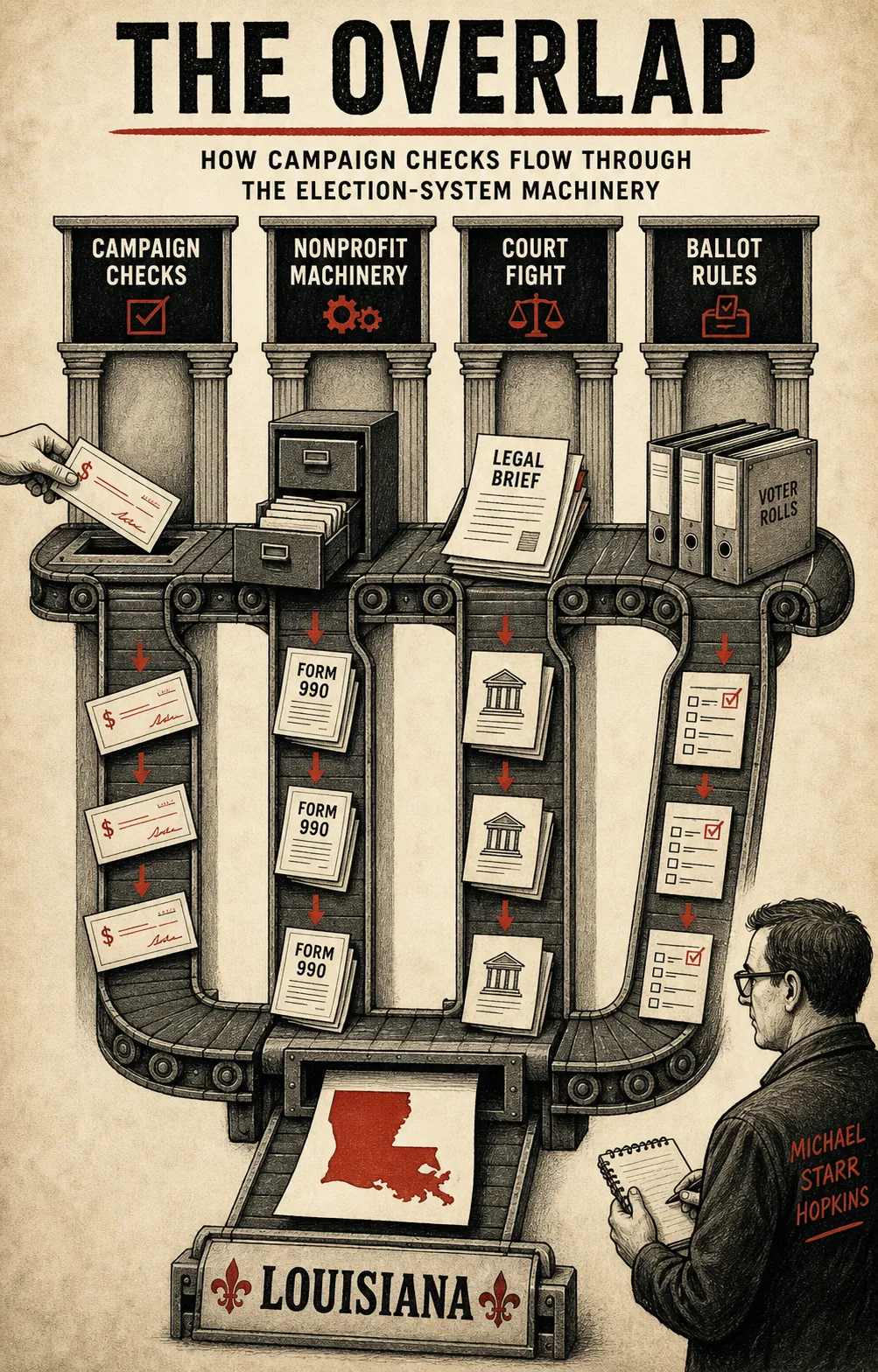
The Court Kingpin’s $73 Million Side Hustle
Leonard Leo’s Side Hustle
The court fight had robes.
The money had invoices.
That is the part America keeps being trained not to see.
We are told to look at the final scene: the Supreme Court opinion, the polished legal theory, the nonprofit with a patriotic name, the public statement about election integrity. We are not supposed to stare too long at the route underneath it. The donor-advised fund. The 501(c)(4). The legal alias. The consulting contract. The for-profit firm. The same small circle of people building the argument, funding the network, shaping the judges, and then telling voters the whole thing is neutral.
I have sat in enough political rooms to know how power behaves when it thinks nobody is taking notes.
It does not usually announce itself as corruption. It arrives as a memo, a grant, a board seat, a vendor agreement, a litigation strategy, a social-welfare nonprofit, a perfectly legal sentence that sounds too boring for ordinary people to fight.
That is where Leonard Leo lives.
Not outside the system.
Inside the wiring.
Leo is the Federalist Society co-chair who helped shape Donald Trump’s judicial pipeline, including the three Supreme Court appointments that locked in the current conservative supermajority: Neil Gorsuch, Brett Kavanaugh, and Amy Coney Barrett. He is also the chairman of CRC Advisors, a for-profit political consulting firm. ProPublica has described him as a central architect of the right’s Supreme Court majority and reported that his network has funded groups trying to influence major Supreme Court cases involving elections and civil rights.
So no, this is not only a story about ideology.
It is a story about the business model underneath the ideology.
The Machine
In 2021, Chicago businessman Barre Seid transferred Tripp Lite, his electronics manufacturing company, to Marble Freedom Trust, a nonprofit controlled by Leo. Tripp Lite was then sold to Eaton for about $1.65 billion. ProPublica and The Lever reported that the structure avoided as much as $400 million in taxes and produced a roughly $1.6 billion political-advocacy war chest.
That is not a donation. That is a private political treasury.
And it did not land in a vacuum.
The Marble Freedom Trust sits inside a broader Leo-aligned ecosystem that includes the 85 Fund, the Concord Fund, the Rule of Law Trust, and nonprofit vehicles whose donors are often hidden from the public. The names sound interchangeable because that is part of the architecture. If ordinary people cannot follow the route, ordinary people cannot challenge the route.
Here is the grocery-store sentence:
The same network that helped pick the judges also built a money route around the cases those judges hear.
That sentence matters because election law is not academic. It decides who gets registered, who gets challenged, who can vote by mail, who has to cure a ballot, who gets counted, whose map survives, and whose lawsuit has enough fuel to keep going until the rule changes.
The Receipt
The 85 Fund houses the Honest Elections Project, one of the groups that turned “election integrity” into a polished legal and political product.
The Guardian and OpenSecrets reported that the Honest Elections Project was tied to a dark-money network already involved in pushing conservative judicial nominees. The same report said the project spent $250,000 on anti-mail-voting ads in 2020, facilitated letters to election officials using misleading voter-roll data, and filed briefs in voting cases across multiple states.
ProPublica later reported that the Honest Elections Project, an initiative inside the 85 Fund, backed the plaintiffs in Moore v. Harper, the Supreme Court case that asked whether state legislatures could set federal-election rules without state-court oversight. The Brennan Center described that theory as one that would give state legislatures wide authority over federal elections and free them from state constitutional checks. The Supreme Court rejected the theory in 2023, but the fact that the theory reached the Court tells you something about the machine.
The machine does not need to win every case.
It needs to keep moving the edge of the argument.
Issue One traced more than $590 million since January 2020 to groups that became part of the Only Citizens Vote Coalition, a network pushing false election narratives around noncitizen voting. In that analysis, the 85 Fund alone accounted for $413 million from seven donor organizations. It also houses the Honest Elections Project.
That is the election-integrity business model in one paragraph:
The donor disappears.
The institution remains.
The legal theory gets filed.
The voter gets called suspicious.
The $73 Million Question
In April 2023, Campaign for Accountability filed an IRS complaint alleging that Leo caused nonprofits in his network to pay him, directly or indirectly, more than $73 million from 2016 through 2021 through his for-profit firms, BH Group and CRC Advisors.
That is an allegation, not a court finding.
Say it cleanly.
The Guardian reported the complaint and Leo’s response. Leo said his clients’ money was put to work effectively and argued that the watchdog’s own funding deserved scrutiny. A lawyer for groups linked to Leo told Politico the complaint was “sloppy, deceptive and legally flawed,” according to The Guardian.
But the payments themselves are not imaginary. ProPublica reported from tax records that the 85 Fund paid CRC Advisors $22 million in 2021 and that the Concord Fund paid CRC Advisors nearly $8 million over a year, with Concord also paying BH Group $500,000.
There is no rule that says a nonprofit can never pay a connected for-profit vendor. The legal question is whether the deal is fair, documented, and serving the nonprofit’s exempt purpose rather than private benefit.
The public question is less delicate:
How many doors does clean money need?
The Investigation
In August 2023, Politico reported that DC Attorney General Brian Schwalb had opened an investigation into Leo and his nonprofit network. The Guardian summarized the reporting and said the scope of the investigation was unclear. Democracy Now, summarizing Politico, noted that the 85 Fund had recently relocated from Virginia to Texas.
House Judiciary Chair Jim Jordan and House Oversight Chair James Comer responded by demanding information from Schwalb’s office about the investigation. Their official committee release framed the probe as politically motivated and requested documents related to Leo-affiliated nonprofits, including the 85 Fund, Rule of Law Trust, Concord Fund, and Marble Freedom Trust.
So the pattern looks like this:
First, the watchdog complaint.
Then, the DC probe.
Then, congressional pressure on the investigator.
Then, a nonprofit universe arguing jurisdiction, donor privacy, and political targeting.
That is not a side plot. That is the defense system.
The money route gets complicated. The oversight route gets attacked. The voter is told not to worry their little head about the paperwork.
The Conflict That Writes Itself
This is where the language has to stay exact.
The claim is not that Leonard Leo bought a specific vote in a specific case. Do not make the argument smaller by making it reckless.
The claim is structural.
Leo helped build the judicial pipeline that reshaped the federal courts. Leo-aligned nonprofits fund litigation, amicus briefs, policy shops, election-integrity campaigns, and donor-hidden infrastructure around the same voting-rule fights those courts hear. Leo also chairs a for-profit consulting firm that has been paid millions by nonprofits in that universe.
That is the sentence.
That is the scandal.
When the same network helps build the bench, finance the arguments, and bill the nonprofits, voters are not looking at neutral traffic. They are watching private power learn how to pass itself off as public law.
The Translation
People hear “dark money” and their eyes glaze over.
Good. That is what dark money wants.
It wants the story to sound like a compliance seminar. It wants voters to hear “501(c)(4)” and reach for their phone. It wants democracy to be boring enough that only lawyers and donors stay in the room.
So translate it.
If a billionaire gives $1.6 billion into a political nonprofit controlled by the man who helped shape the Supreme Court, that is power.
If that network funds groups pushing aggressive election theories, that is power.
If watchdogs allege nonprofit money was routed to the same man’s own for-profit firms, that is power plus invoices.
If the DC Attorney General opens a probe and House Republicans demand information about that probe, that is power defending itself.
And if voters are only invited into the conversation after the brief has been filed, the judge has been confirmed, the roll has been challenged, and the rule has already moved, that is not democracy working quietly.
That is democracy being managed.
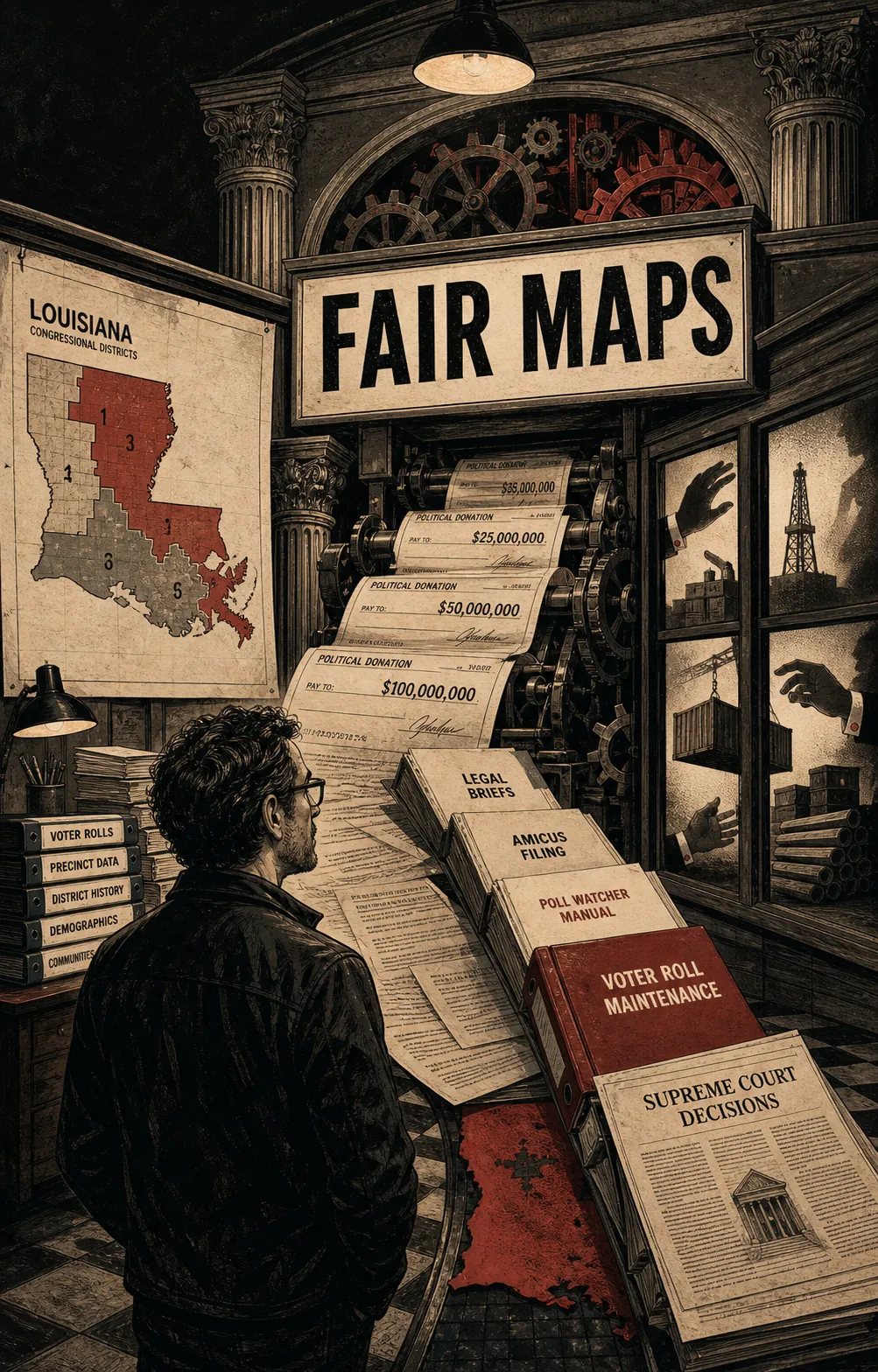
The Schwab Problem
One donor route deserves a flashing red light.
Issue One identified donor-advised-fund money as a major part of the network funding groups that later joined the Only Citizens Vote Coalition. Donor-advised funds are marketed to mainstream investors as a tax-efficient way to give. But in politics, they can become a fog machine.
The public can see that money arrived at the receiving nonprofit.
The public often cannot see who directed it.
That is the trick. The check gets a mask. The nonprofit gets a patriotic name. The campaign gets the talking point. The court gets the brief. The voter gets the burden.
Election integrity, in this universe, is not a prayer.
It is a purchase order.
The Verdict
The Court did not move by accident.
The election-integrity machine did not appear by weather.
The money built institutions. The institutions built arguments. The arguments found judges. The judges decided rules. The rules shaped the next electorate.
That is why this matters now.
Because the fight over democracy is being sold to voters as a fight over fraud, when the more proven fraud is the presentation. A movement funded by hidden money, legal aliases, and nonprofit pass-throughs wants to call itself clean while treating the ballot box like a crime scene.
Here is the verdict:
The voter gets the line.
The donor gets the law.
The nonprofit gets the tax status.
The consultant gets paid.
And democracy gets told to wait outside the room.
The war on voting has a business model.
Leonard Leo is the CFO.
Sources
- ProPublica and The Lever: Barre Seid, Marble Freedom Trust, and the $1.6 billion transfer
- ProPublica and The Lever: Leo-aligned nonprofits, election cases, and CRC Advisors payments
- ProPublica: Leonard Leo and the Supreme Court conservative supermajority
- Issue One: Only Citizens Vote Coalition money map
- The Guardian: Campaign for Accountability complaint and $73 million allegation
- The Guardian: DC Attorney General investigation reporting
- House Judiciary Republicans: Jordan and Comer inquiry to the DC Attorney General
- The Guardian and OpenSecrets: Honest Elections Project voting-restriction work
- Honest Elections Project: Moore v. Harper amicus announcement
- Brennan Center: independent state legislature theory background