| | BURN THE PLAYBOOK | THE FRIDAY RECEIPT INDEX | BTP DEEP · JULY 17, 2026 |
| |
|
|
Sue Yourself. Settle With Yourself. Send Taxpayers the Bill. |
The Friday Receipt Index: A federal judge found that Donald Trump’s lawsuit against his own IRS was brought in bad faith. The lawyer who signed the deal is now asking the Senate for a promotion. |
BTP Deep · July 17, 2026 |
CORRECTION · JULY 17, 2026: The published email blurred the May 18 settlement agreement with a separate May 19 release order and estimated the proposed fund at about $5.30 per person. The broad noncash protection came from the separate release order. Using the Census Bureau’s July 1, 2026 population projection, the amount is about $5.18 per person. The email cannot be recalled; this web version is corrected. |
|
The Justice Department is supposed to represent the United States. In this case, the United States never showed up. |
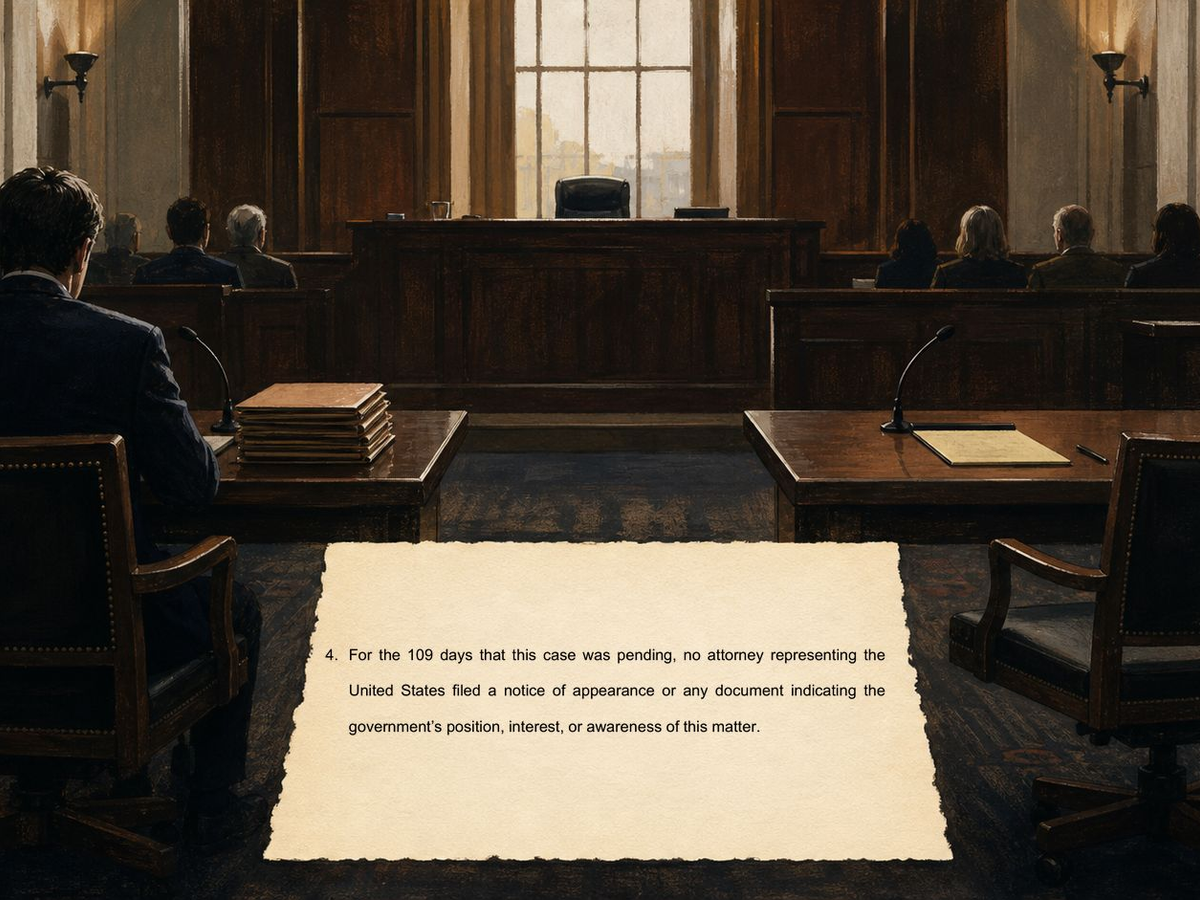
For 109 days, President Donald Trump sued the IRS and Treasury Department—agencies he controls—for $10 billion. No government lawyer appeared or filed a defense. When the judge asked whether the sides were actually opposed, neither answered. They announced a deal and dismissed the case. |
The settlement agreement gave Trump a formal apology and created a $1.776 billion fund for people and groups claiming “weaponization” or “lawfare.” A separate May 19 release order signed by Acting Attorney General Todd Blanche purported to protect Trump, relatives, companies and affiliates from past tax audits and other federal actions. Officials chosen by the attorney general—and removable by the president—would run the fund. |
On Monday, U.S. District Judge Kathleen Williams found improper purpose and bad faith. Her order says the case gave legal cover to benefits unavailable through a real court fight. The parties may no longer use the agreement as proof of a settlement in official proceedings. |
The grocery-store version is simpler: the president sued his own government, his own government did not defend itself, and the proposed solution put his former lawyer in charge of the deal. |
The fair case |
Trump had a real injury. Former IRS contractor Charles Littlejohn illegally disclosed Trump’s tax information, pleaded guilty, and received a five-year prison sentence. Tax privacy still matters when the victim is powerful or unpopular. |
DOJ says the named plaintiffs received no cash. It described the fund as nonpartisan, subject to anti-fraud controls and possible audit, with unused money returning to the government. It cited the Keepseagle settlement involving Native American farmers as precedent. |
That is the strongest defense. It deserves to be heard. |
It does not answer the court’s finding that the government was never a real opponent. |
The Post-Workout Recovery Secret You’re Sleeping On |
|
Your muscles rebuild when you’re sleeping, and not getting enough sleep can affect your post-workout recovery. CBDistillery’s sleep products are formulated to support your sleep naturally; in a 2021 study, participants reported sleeping an hour longer on average after taking CBDistillery’s combination of CBD and CBN. Save 25% with code SLEEPMORE. |
Support Your Sleep |
How the Index works |
Each entry is scored against the same 100-point test: |
Private benefit from public power — 25 points: Did the action benefit the president, his family, associates, or political allies? Collapsed independent process — 20 points: Was the government’s duty to defend taxpayers, enforce law, or check conflicts weakened? Taxpayer exposure — 20 points: How much public money or financial protection was put at risk? Rule bypass — 15 points: Did the action evade a statute, court review, ordinary settlement practice, or a real opposing party? Secrecy and weak oversight — 10 points: Could decisions be made without public reasons, appeal, or meaningful outside review? Precedent risk — 10 points: Could the move become a reusable playbook for future presidents?
|
No points are awarded for partisan outrage. Scores reflect the public record and are reduced where the practical effect is blocked, abandoned, or legally unsettled. |
1. The Self-Settlement — 99/100 |
Breakdown: Private benefit 25/25 · Collapsed process 20/20 · Taxpayer exposure 20/20 · Rule bypass 15/15 · Secrecy 9/10 · Precedent risk 10/10 |
Core record: Judge Williams found there was never real opposition between the parties and “never a question as to who would prevail.” Trump sued agencies he controls; the government never appeared; the deal arrived after the judge raised the lack of a real dispute. |
Strongest defense: Trump sued in his personal capacity over a proven illegal leak. Presidents do not lose their private legal rights when they take office. |
Rebuttal: Private rights still require a real defendant. The court found Trump controlled the agencies and the litigation position on the other side. Calling the desks “plaintiff” and “defendant” does not create a fight when the same boss controls both rooms. |
Why it matters: A normal taxpayer cannot control the IRS’s lawyers and negotiate the remedy with a former personal attorney running DOJ. |
Campaign consultant’s note: If your opposition research memo begins with “the candidate sued himself,” clear the afternoon. |
Bottom line: This was not government settling a hard case. The court found it was government arranging its preferred ending. |
2. The Blanket Release — 97/100 |
Breakdown: Private benefit 25/25 · Collapsed process 19/20 · Taxpayer exposure 19/20 · Rule bypass 15/15 · Secrecy 9/10 · Precedent risk 10/10 |
Core record: The separate release order signed by Acting Attorney General Todd Blanche purported to protect Trump, relatives, companies, and affiliates from past tax audits and from claims or investigations that had been or could have been brought before federal agencies. At Wednesday’s confirmation hearing, Blanche defended it as an agreement that past audits would end. |
Strongest defense: Broad releases are common because settlements are supposed to buy peace. DOJ also says the agreement did not excuse future violations. |
Rebuttal: This release reached far beyond the leaked-tax-return lawsuit. Judge Williams wrote that it purported to bar future audits tied to past filings and directly conflicted with the federal law barring high-level executive officials from asking the IRS to start or stop a particular person’s audit. |
Why it matters: Most Americans live with years of possible tax review. This deal tried to turn presidential control into protection no ordinary filer could negotiate. |
Performance review: Client service: elite. Public service: please see the court’s order. |
Bottom line: The most valuable part of this deal may never have been the money. It was the promise that the government would stop looking. |
3. The $1.776 Billion Fund — 94/100 |
Breakdown: Private benefit 23/25 · Collapsed process 17/20 · Taxpayer exposure 20/20 · Rule bypass 14/15 · Secrecy 10/10 · Precedent risk 10/10 |
Core record: The agreement called for $1.776 billion from the permanent Judgment Fund. Five members could keep their procedures private, report awards confidentially to the attorney general, and operate without appeal or judicial review. Claimants needed to assert “weaponization” or “lawfare”—terms the agreement did not legally define. |
Strongest defense: DOJ said the fund would be open across party lines, use fraud controls, and return unused money. The agency cited Keepseagle as precedent. |
Rebuttal: Keepseagle followed roughly a decade of contested litigation, discovery, class notice, and a fairness hearing. This case lasted 109 days; the government filed nothing. Judge Williams said the $1.776 billion figure suggested branding, not a careful damages calculation. |
Why it matters: Using the Census Bureau’s July 1, 2026 population projection, that is about $5.18 per person in America for a fund using political language as its eligibility standard, with awards outside public review. |
Warning label: Five appointees. Undefined claims. Confidential awards. No appeal. Taxpayers included automatically. |
Bottom line: Congress did not build this program. A settlement between aligned parties tried to do it with a permanent pot of taxpayer money. |
4. The Government That Did Not Defend Itself — 90/100 |
Breakdown: Private benefit 20/25 · Collapsed process 20/20 · Taxpayer exposure 15/20 · Rule bypass 15/15 · Secrecy 10/10 · Precedent risk 10/10 |
Core record: For all 109 days, no attorney representing the United States filed an appearance or any paper stating the government’s position. The court contrasted that silence with DOJ’s vigorous defense of similar tax-leak cases, where it challenged filing deadlines, disputed damages, and argued that a contractor was not a federal employee. |
Strongest defense: Settlement can save money. Government lawyers need not litigate every defense to the bitter end. |
Rebuttal: They still must defend the United States’ interests. The judge found the claims appeared late and the billions requested lacked legal support. The silence removed the institution assigned to say no. |
Why it matters: Every dollar conceded belongs to people outside that room. The public’s lawyer cannot become private counsel for the president. |
Congressional Yelp review: Ordered an adversarial legal system. Received a consent motion and an apology. |
Bottom line: The government did not lose its defense. It chose not to mount one. |
5. The “Dead” Agreement With a Pulse — 84/100 |
Breakdown: Private benefit 18/25 · Collapsed process 15/20 · Taxpayer exposure 17/20 · Rule bypass 14/15 · Secrecy 10/10 · Precedent risk 10/10 |
Core record: Blanche says the fund is dead, and a June 12 federal injunction in Virginia kept it blocked. But the parties did not amend the agreement, and Trump did not sign a renunciation. Republican Sen. John Cornyn pressed that gap Wednesday. Judge Williams said one side’s ability to declare the fund dead was evidence the parties were aligned. |
Strongest defense: DOJ has said in court filings that it will not proceed, and the fund remains blocked. The immediate payout risk is therefore lower. |
Rebuttal: The Florida court did not decide whether the private agreement remained valid; it barred the parties from using it as an official settlement. “We are not doing it” is not rescission or a final judgment resolving every term. |
Why it matters: Government promises should not depend on which official is standing at a microphone. If a billion-dollar obligation can be born in a press release and killed by testimony without changing the signed paper, the public does not have a rule. It has a mood. |
Achievement unlocked: Schrödinger’s settlement—dead for Congress, alive enough to keep judges asking questions. |
Bottom line: The fund is blocked. The legal playbook that produced it is not. |
The operator’s view |
I have worked in campaigns and courtrooms long enough to know that titles are duties: plaintiff, defendant, government lawyer, private lawyer, attorney general. The system depends on those duties pointing in different directions when power needs checking. |
Here, those lines collapsed. Trump’s former personal lawyer signed for the United States, then told the Senate that ending past audits was part of settlement. Now the Senate is considering him for permanent attorney general. |
The confirmation question is whether the country’s lawyer understands that the client is the United States—not the man who gave him the job. |
What to watch next |
Whether the Senate Judiciary Committee advances Blanche’s nomination. The committee held official hearings July 15 and 16; no committee vote record was located by the July 17 research cutoff. Whether Trump or the other plaintiffs renounce the fund and release provisions in writing. Whether the Virginia litigation or Congress shuts the door on using the Judgment Fund for a political compensation program.
|
Do the work |
Read the court’s 56-page order. It is unusually plain, and it lets you judge the findings without borrowing anyone’s outrage. |
Primary action: Read the July 13 court order. |
The bottom line |
The original tax leak was a crime. Punishing it was justice. Turning that injury into audit protection, a political payout fund, and a promotion for the president’s former lawyer was something else. |
The Justice Department is supposed to represent the United States. A federal judge found that, in this case, it had retained a legacy client. |
Sources |
U.S. District Court order, Trump v. IRS, July 13, 2026 DOJ settlement agreement, May 18, 2026 Acting Attorney General’s release order, May 19, 2026 DOJ announcement and defense of the fund, May 18, 2026 26 U.S.C. § 7217, prohibition on executive influence over IRS audits Senate Judiciary account of Blanche’s July 15 testimony Associated Press report on the hearing and Republican vote uncertainty, July 15, 2026 U.S. Census Bureau population projection for July 1, 2026 Federal injunction blocking the fund, National Treasury Employees Union v. Trump, June 12, 2026 Senate Judiciary Committee hearing on Todd Blanche’s nomination, July 15, 2026
|