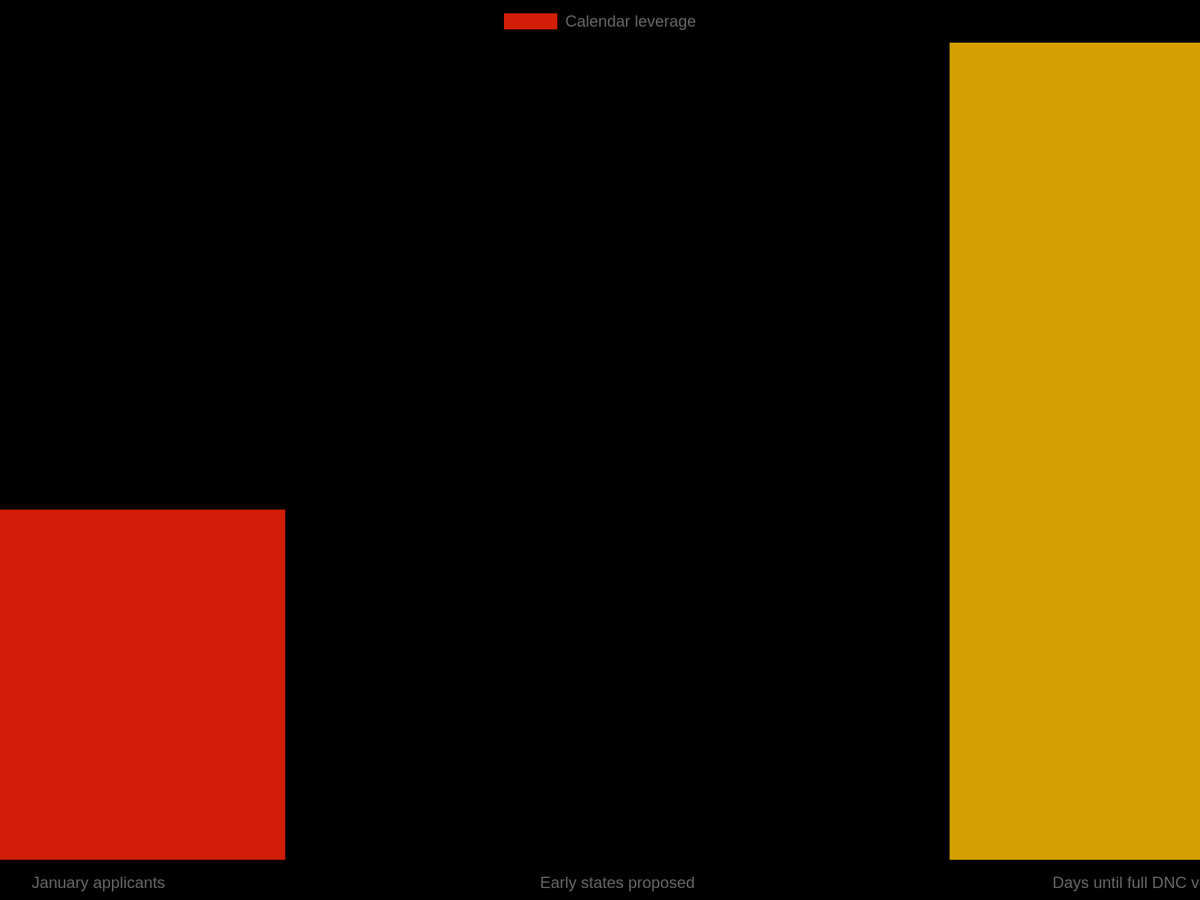
Burn the Playbook | Independent. Editor-owned. Built for people who still want the record. | Six states. One calendar. The 2028 fight already started. | By Michael Starr Hopkins | The 2028 race has not been announced. The leverage has. | On January 31, 2026, the DNC Rules and Bylaws Committee said it had received 12 applications for the early presidential nominating window and advanced all 12 states to the next phase. On July 24, 2026, the same panel proposed six early states for 2028: South Carolina on January 22, Nevada on February 1, New Hampshire on February 8, New Mexico on February 15, Michigan on February 22, and Virginia on February 29. | The full DNC still has to vote at its August 13-15 summer meeting. That matters. This is not final until the full committee acts. But campaigns do not wait for the confetti. They read the calendar like a bank statement. | | Source labels: DNC Rules and Bylaws Committee and Associated Press. | The Machine | An early state is not just a date. It is a filter. It tells candidates whose issues matter first, whose voters get courted first, whose local press gets fed first, and whose version of the party becomes the front door for the whole country. | The January applicant list was Delaware, Georgia, Illinois, Iowa, Michigan, Nevada, New Hampshire, New Mexico, North Carolina, South Carolina, Tennessee, and Virginia. That was the audition room. The July proposal narrowed the stage to six states and left Iowa outside the early window. | That is why the calendar is the campaign before the campaign is public. If a state is early, potential candidates build there now. If a state missed, local leaders know exactly what kind of leverage they lost. If donors and operatives believe the order will hold, the money starts moving before most voters know there is a fight. | The Proof | The DNC says the proposed early window is designed to battle-test candidates with a more diverse and practical map. Its July 24 release said the six-state window includes 4.6 million Black people, 4.2 million Latinos, 1.4 million Asian American, Native Hawaiian, and Pacific Islander people, 370,000 Native Americans, 14 million non-college voters, more than 2.8 million young voters, more than 1.1 million union workers, and more than 2.1 million veteran and military voters. | That is the sales pitch. The pressure point is whether those voters get real power or just become a demographic slide deck for candidates who still chase the same donors and consultants. | | Source label: DNC July 24, 2026 early-window proposal. Native voters are shown in units of 100,000. | Who Pays | The states that did not make the cut pay first. Their local chairs, activists, reporters, unions, churches, community groups, and young organizers lose the power that comes from forcing national candidates to show up early. | Voters pay next. A calendar can reward retail politics, television money, state-party relationships, donor access, racial coalition work, labor organizing, rural persuasion, or consultant comfort. The order decides which version of politics gets practiced before the country sees a debate stage. | Between The Lines | South Carolina first is not just nostalgia for Biden's 2020 comeback. Nevada second is not just a Western stop. New Hampshire third is not just compromise with tradition. New Mexico, Michigan, and Virginia are not just extra dates. The sequence tells candidates which America they must learn how to talk to first. | The danger is that the party talks about diversity in the calendar while letting money decide who can afford to campaign across it. A better map still needs a better politics. | Hiring | This fight needs investigators, organizers, lawyers, data people, policy writers, local reporters, and designers who can turn records into pressure. | | Bottom Line | Twelve states got into the room in January. Six were proposed in July. The public will call this process. Campaigns will call it the map. Power will call it a head start. | One action: Save the six-state order now. When the 2028 candidates start showing up, check whether they are actually listening to those voters or just renting the scenery. | Watch · BTP | | Sources | | Keep BTP independent: Share this with someone who thinks the race starts when candidates announce. | Subscribe to Burn the Playbook | Manage preferences | Unsubscribe |
|