In partnership with |  |
|
| Burn the Establishment Playbook | Est. 2025 · Free to the People |
| ★ Independent · Editor-Owned · No Paraphrase ★ Burn the Playbook "The newsletter DC reads and hopes you don't." | | Morning Edition | Vol. I · Washington | Fri, Jul 10, 2026 |
|
|
|
Eighteen seats. That's how many U.S. House districts the Cook Political Report calls toss-ups as of June 18, 2026 — fourteen held by Republicans, four by Democrats. |
The number is small because the map is small. The consequence is not. |
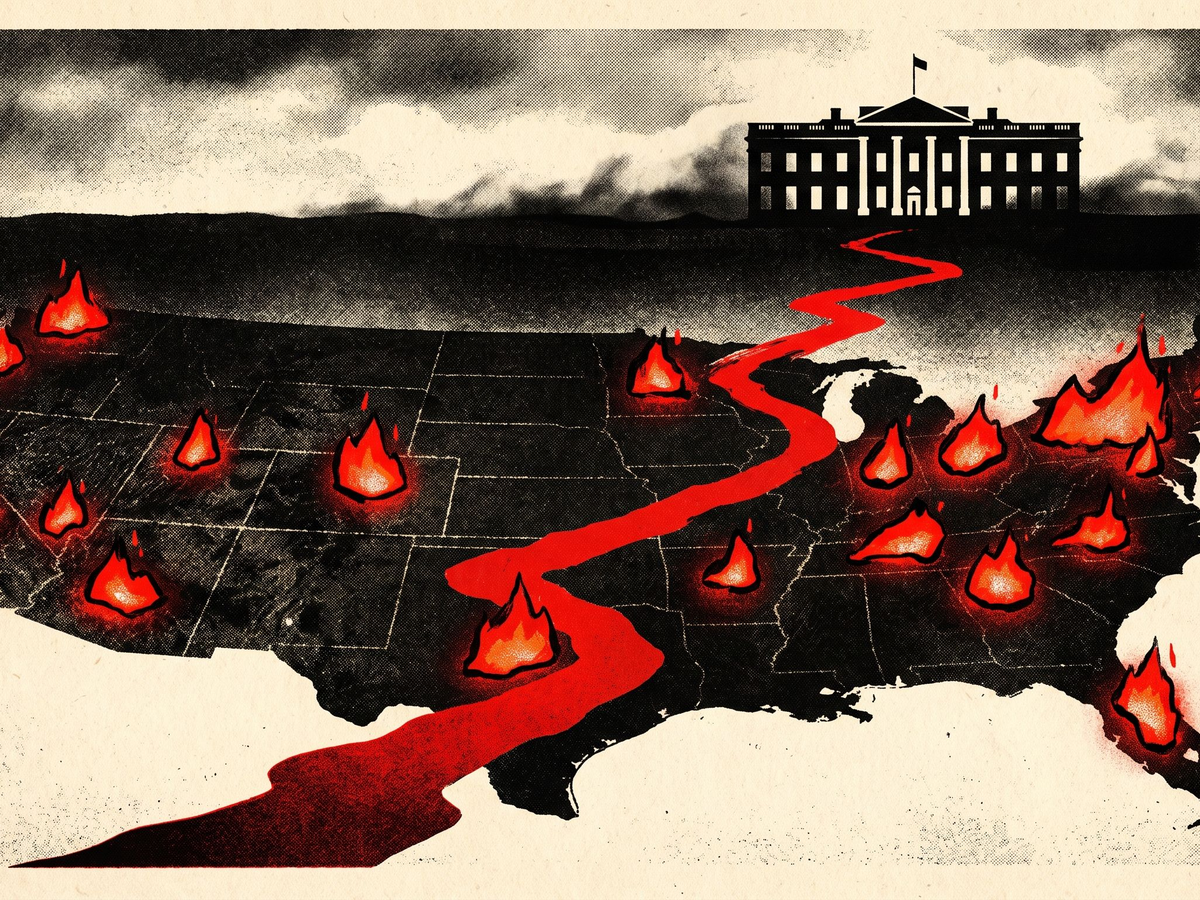
Whoever holds the gavel in January 2027 sets the procedural floor for the 2028 White House race. |
Why this, why now |
The presidential race does not start with the first debate. It starts in the House districts that decide who controls the floor, the committees, the subpoena power, the budget fights, and the election-law pressure around 2028. |
Both parties are selling a "path to the majority." The path is 18 districts. National coverage treats them like standalone races when they're really the on-ramp to the presidency. |
The big picture |
Step back and ask the question that never makes the chyron: why are there only 18 competitive seats out of 435 in the first place? |
Because the maps were drawn that way. Decades of gerrymandering — both parties, wherever they held the pen — shrank the number of districts where a general election is a real contest. Most members of Congress now win their seat in a primary, in front of the most partisan sliver of their own party. The general is a formality. |
That's why the majority swings on a sliver. Republicans opened this Congress 219 seats to 215 — the slimmest majority either party has carried since the early 1930s. A margin you can fit in a school bus. When 400-plus seats are pre-decided, the 18 that aren't stop being local races. They become the whole national election, and everyone with a budget knows it. |
So when you hear "battle for the House," translate it: a fight over roughly four percent of the chamber, waged with nine-figure budgets, deciding one hundred percent of the gavel. |
By the Numbers |
18 House toss-up seats as of June 18, 2026 — the entire battlefield where the 2028 presidency starts — per Cook Political Report 14 Republican-held toss-ups across eleven states, concentrated in Arizona, Iowa, and Pennsylvania — per The Hill 4 Democratic-held toss-ups: FL-25, OH-9, TX-34, and WA-3 — per 270toWin 10 → 4 — Democratic toss-ups fell from as many as ten earlier this cycle to four by June 18, while the Republican list grew to fourteen — per 270toWin ratings table
|
You Already Have a Take on What AI Does Next |
|
OpenAI or Anthropic? Which model leads the next benchmark? Which company ships the next major breakthrough? |
If you follow AI closely, you already have opinions on where the industry is headed. Kalshi lets you trade on real-world AI and technology events, with markets that move as models launch, benchmarks drop, and announcements happen. |
The people who follow this space most closely often see the story developing before everyone else. Put that knowledge to work and trade what you think happens next. |
Trade $25, Get Up to $500 |
Bonus credit varies from $15 to $500. Terms apply. |
The Republican map |
Cook's Republican-held toss-ups: AZ-1 (open), Juan Ciscomani (AZ-6), David Valadao (CA-22), Gabe Evans (CO-8), Mariannette Miller-Meeks (IA-1), Zach Nunn (IA-3), Tom Barrett (MI-7), Tom Kean Jr. (NJ-7), Mike Lawler (NY-17), Ryan Mackenzie (PA-7), Rob Bresnahan (PA-8), Scott Perry (PA-10), Jen Kiggans (VA-2), and Derrick Van Orden (WI-3). |
Fourteen seats across eleven states — and look where they stack up. Arizona, Iowa, and Pennsylvania decide House control in 2026 and sit at the center of the presidential math in 2028. |
The House map and the swing-state map are the same map. Same voters, same doors, same fight. |
The Democratic map |
Cook's Democratic-held toss-ups: Jared Moskowitz (FL-25), Marcy Kaptur (OH-9), Vicente Gonzalez (TX-34), and Marie Gluesenkamp Perez (WA-3). |
Earlier this cycle, Cook flagged as many as ten Democratic-held toss-ups. By June 18 it was down to four, while the Republican list grew to fourteen. Watch which way the board is tilting. |
Four exposed seats against fourteen. That's not a prediction — that's the scoreboard. |
What it means for 2028 |
A House majority in January 2027 controls floor scheduling, oversight committee gavels, impeachment referrals, and the appropriations bills that fund the 2028 election infrastructure. Eighteen districts decide all of that. |
The Electoral Count Reform Act changed the certification rules after January 6, but it did not make Congress irrelevant. Congress still writes election funding. Congress still oversees the agencies. Congress still creates the weather around the next presidential contest. |
Here's the question almost nobody asks: which of the 18 toss-up districts overlaps the swing state you live in — and how much of the 2028 ground game already lives there? |
Between the lines |
Understand what a rating actually does. Cook doesn't just describe these races — the list routes the money. The moment a seat moves to "toss-up," the committee budgets, the super PAC buys, and the recruitment calls all reshuffle around it. The map is a forecast, and the forecast is a bank wire. |
And understand what the Electoral Count Reform Act did and didn't do. After January 6, Congress raised the bar for objecting to a state's electors — it now takes a fifth of each chamber instead of a single member from each — and made explicit that the vice president's role in the count is ceremonial. That's real. It's also not a force field. |
Congress still funds election administration. Committees still hold the subpoenas. The House still sets the temperature for how the 2028 count gets treated. The guardrail got stronger; the drivers still matter. Which is another way of saying: the 18 districts still matter. |
Little Known RMD Strategy Allowed by the IRS |
|
For investors with $1M+ in retirement accounts, the tax code allows specific strategies that can reduce your tax exposure once RMDs begin—but only if used before then. |
The window is open for anyone within ten years of 73. A fiduciary advisor can review which may apply, at no cost. |
Get Matched Today |
|
The playbook they're running |
The frame: they'll sell 2026 as a midterm referendum. The substance: 18 districts that decide who holds the gavel going into 2028. The DCCC money, the NRCC money, the PAC ad buys — all of it lands here. |
What candidates should say: name the 14 Republican-held toss-ups. Name the 4 Democratic-held ones. Name the footprint — Arizona, Iowa, Pennsylvania, and the coasts — that decides them. Then say the quiet part: this is 2028 starting early. |
The cheapest applause line in midterm politics is "hold the line." The line is 18 districts wide. |
The other side |
The honest counterargument: toss-up lists move. Cook re-rates races all cycle, seats will drop on and off this list by October, and a strong national environment for either party could redraw it entirely. |
Fair. But watch what doesn't move: the geography. Arizona, Iowa, Pennsylvania, the exurban coasts — the same terrain shows up cycle after cycle, in the House math and the presidential math, because that's where the country's actual disagreements live. Individual seats will shuffle. The battlefield won't. |
That's why this issue isn't a prediction. It's a map of where the pressure lands. |
What's next |
Cook keeps re-rating through the fall. Watch whether the 18 grows or shrinks by Labor Day — and in which direction. Watch where the DCCC and the NRCC place their first big independent-expenditure buys; the money always confesses before the polls do. |
Then the fixed dates: Election Day, November 3, 2026. The new Congress is sworn in January 3, 2027. The 2028 electoral count itself belongs to the Congress after that — the one seated January 3, 2029. But the gavel won this November runs the House through the entire 2028 campaign: the oversight, the funding fights, the hearings, the weather. The count belongs to the next Congress. The runway belongs to this one. |
If your district is on the list, you are not watching this story. You are in it. |
Your move |
The bottom line: the 2028 White House race is being built right now in 18 House districts you can list on one page. Find your district on Cook's map. If it is one of the 18, your vote and your volunteer hour count twice — once for the House, once for the presidency. |
|
BTP stays free. Members fund the depth. |
Sources |
Cook Political Report 2026 House race ratings, as of June 18, 2026. source The Hill 18 House toss-ups for 2026, named members. source 270toWin Cook 2026 House interactive map. source 270toWin Cook 2026 House ratings table, as of June 18, 2026. source
|
Forward the receipt before the 18 close to 12. |
May the bridges we burn light our path's forward. |
— Michael |