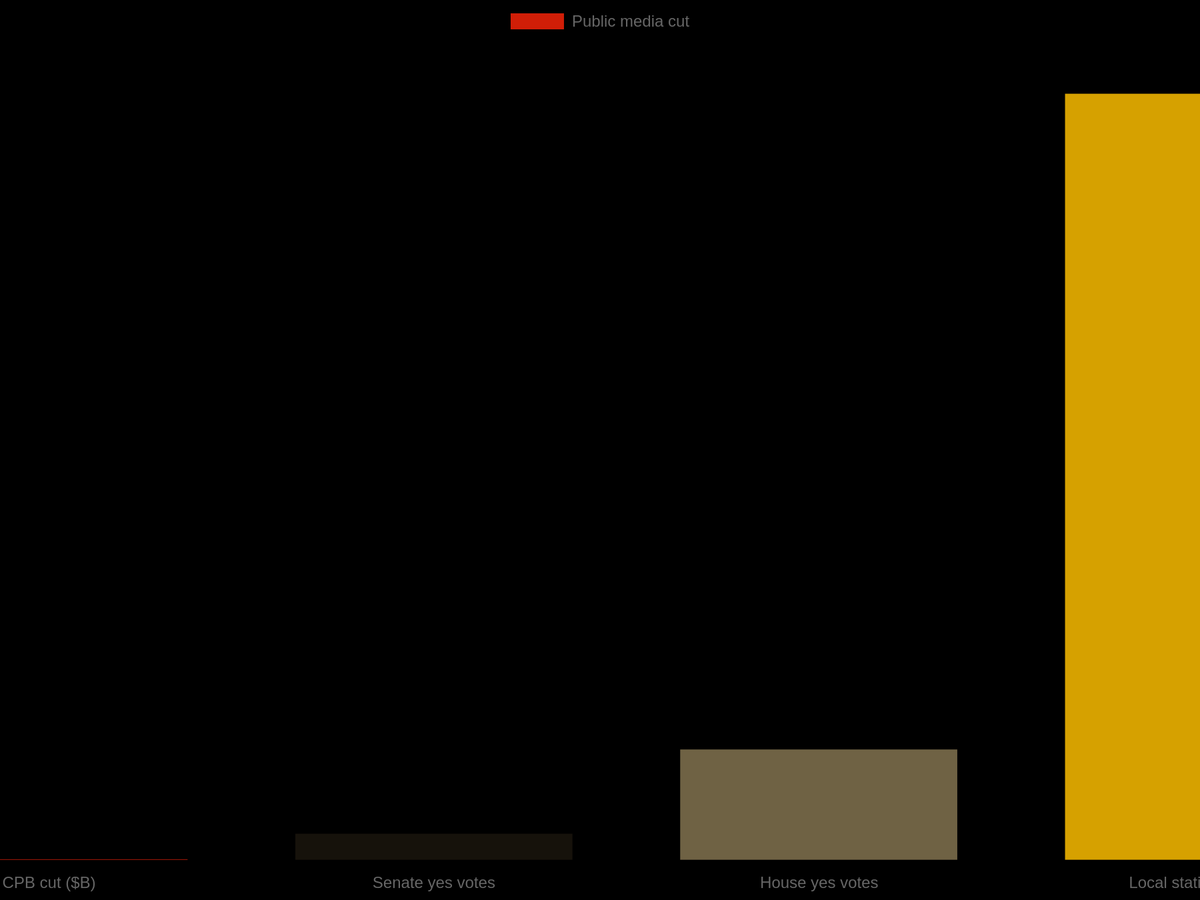
Burn the Playbook | Independent. Editor-owned. Built for people who still want the record. | $1.1 Billion. 51-48. CPB Dissolved. The Map of the Cut. | By Michael Starr Hopkins | The public-media cut was sold as a fight over bias. The damage lands locally. | Congress clawed back $1.1 billion from the Corporation for Public Broadcasting after a 51-48 Senate vote on July 17, 2025 and a 216-213 House vote the next day. CPB was created in 1967 to support public media and help sustain more than 1,500 local radio and television stations. Current later reported that CPB's board voted to dissolve the 58-year-old corporation after federal funding was eliminated. | That is not just a Washington story. It is a map story. The fight was branded as NPR and PBS. The cost lands on rural stations, tribal radio, emergency alerts, children's programming, statehouse coverage, and local news in places commercial media already walked away from. | | Source labels: CPB, AP, Current, Congress coverage, and public-media reporting. | Advertisement | While the Dollar Weakens, Gold Doesn't Ask Permission. | | Physical gold sits outside inflation, banking risk, and government policy and a Gold IRA lets you own it with the same tax advantages you already have. True Gold Republic's free 2026 kit shows you exactly how. | Send me the free kit | The Machine | The trick is to make the target sound national so the local damage looks accidental. Say "NPR bias" enough times and people stop picturing the small station that carries storm warnings, school closures, public-health updates, city council coverage, and tribal language programming. | CPB warned that eliminating its funding would hurt local stations, especially rural and underserved communities. AP reported that cuts threatened Native American public radio stations serving more than 1.5 million people, including 59 tribal stations where about three dozen could face shutdown. PBS NewsHour described rural public media as especially exposed, with nearly 250 rural stations in the danger zone. | That is the part the culture-war script leaves out. The cut does not hit a cable pundit first. It hits the station that tells people whether the road is washed out. | The Proof | Current reported in January 2026 that CPB intended to file dissolution paperwork after its board unanimously voted to dissolve. CPB's own statement after the rescission warned that the vote would force many local public radio and television stations to shut down, with harm to educational content, local journalism, and emergency alerts. | CBS New York reported that NJ PBS would shut down after June 30, 2026 after federal and state funding cuts and a failed agreement to continue management of the network. Free Press cited a New York Times analysis finding 245 rural stations at risk of closure because rural stations depend more heavily on CPB money than urban stations with bigger donor and underwriting bases. | | Source labels: Free Press/New York Times analysis, AP Native public media reporting, PBS NewsHour, and CBS New York. | Who Pays | The person who lives far from a big media market pays. The parent whose kid watches PBS Kids because preschool is expensive pays. The elder who hears emergency information in a Native language pays. The statehouse reporter who is already trying to cover too much with too little pays. The community pays when the last consistent public signal gets weaker. | This is how austerity hides. It does not announce, "We are taking away local information." It says, "We are fighting bias," then waits for the rural station to run out of money. | Between The Lines | Public media is easy to caricature when the target is a national brand. It is harder when the target is a local station in Alaska, New Jersey, Mississippi, Arizona, or a tribal community where commercial media never built a replacement. | The line that matters is simple: if the station closes, the national argument is over. The local silence stays. | Hiring | This fight needs investigators, organizers, lawyers, data people, policy writers, local reporters, and designers who can turn records into pressure. | | Bottom Line | $1.1 billion was clawed back. The Senate vote was 51-48. CPB is dissolving after 58 years. The national fight was sold as a shot at NPR. The real damage is the local station that goes quiet when people need it loud. | One action: Look up your local public radio or TV station and see what it says federal funding pays for. That is the part of the story the slogan leaves out. | Watch · BTP | | Sources | | Keep BTP independent: Share this with someone whose local station does more than play the national feed. | Subscribe to Burn the Playbook | Manage preferences | Unsubscribe |
|