They Just Moved the Shutdown Until After You Vote
Congress kept the lights on past the September 30 deadline and moved the real fight to December 11, five weeks after the midterms.
The full report is below — also published on Beehiiv — with its receipt trail and source ladder. Every claim below clears at two-of-three independent sources before publication, with right-of-reply offered to every named subject.
They Just Moved the Shutdown Until After You Vote
Congress kept the lights on past the September 30 deadline and moved the real fight to December 11, five weeks after the midterms.

Michael Starr Hopkins
October 04, 2026
 | |||
★ Independent · Editor-Owned · No Paraphrase ★ Burn the Playbook "The newsletter DC reads and hopes you don't." | |||
|
Fiscal year 2026 ended at midnight on September 30, and the government never closed. In a normal year in this town, that date comes with a countdown clock, cable chyrons and hundreds of thousands of federal workers checking their bank balances.
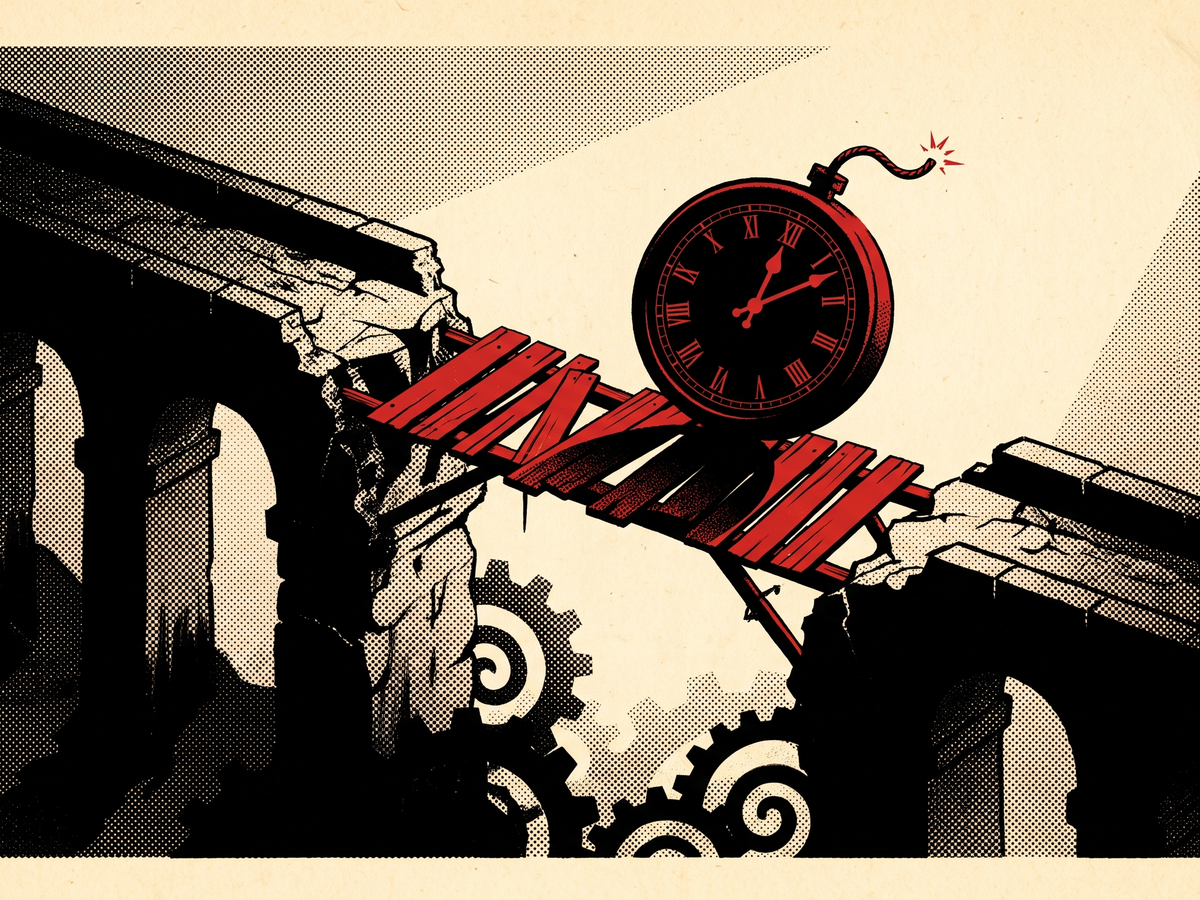
This year the lights stayed on. Not because anybody solved anything. Because Congress quietly moved the fight to December 11, five weeks after you vote.
That date is the whole story. Twenty years inside campaigns taught me that when both parties agree on something this fast, look at the calendar before you look at the bill.
They didn't avert a shutdown. They rescheduled it for after the ballots are counted.
Start with the votes and the dates. They tell you who agreed, and when the bill comes due.
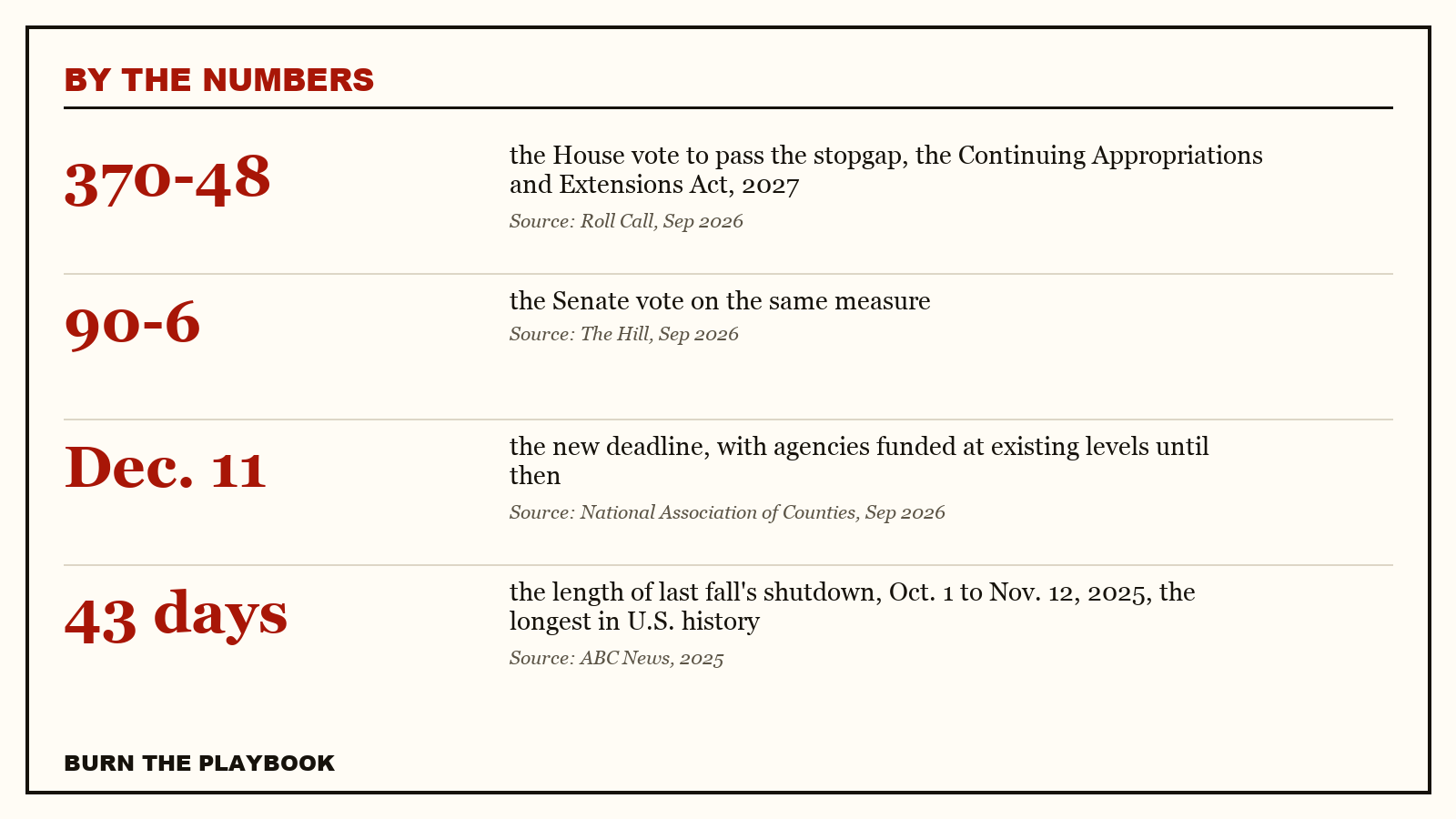
By the Numbers
370-48: the House vote to pass the stopgap, the Continuing Appropriations and Extensions Act, 2027, per Roll Call, Sep 2026
90-6: the Senate vote on the same measure, per The Hill, Sep 2026
Dec. 11: the new deadline, with agencies funded at existing levels until then, per National Association of Counties, Sep 2026
43 days: the length of last fall's shutdown, Oct. 1 to Nov. 12, 2025, the longest in U.S. history, per ABC News, 2025
~670,000: federal employees furloughed during that shutdown, with about 730,000 more working without pay, per ABC News, 2025
$11 billion: CBO's estimate of economic output permanently lost under a six-week shutdown, the scenario closest to last fall's 43 days (its eight-week scenario put the loss at $14 billion), per CNBC, citing CBO, Oct. 29, 2025
Ad. BTP earns a commission if you sign up.
If you have been meaning to talk to someone. BetterHelp says it matches you with a licensed therapist by chat, phone or video, with 20% off the first month for new users. See how it works →
Proven: the bill is law. President Trump signed it, and federal funding runs through December 11. The fiscal year turned over on October 1 with no shutdown.
Reported: the deal came together weeks early. Senate Appropriations Chair Susan Collins and Vice Chair Patty Murray announced it, and the White House urged lawmakers to back it, per NBC News.
BTP argues: last year's 43 days scared both parties straight, but only until Election Day. Nobody wanted to run on a closed Social Security office or an unpaid TSA line. So they bought silence through the midterms.
Who benefits. Who pays.
Incumbents benefit. A stopgap means no hard votes on full-year spending, no fights over cuts, nothing a challenger can clip for an ad. Every member gets to go home and say they kept the government open.
The bill also carried a few favors. It blocks a proposed OMB rule on federal financial assistance for the life of the stopgap and delays most of a ban on intoxicating hemp products that was set to start November 12, per Defense One and NACo reporting.
You pay later. Agencies running on a CR can't start new programs or plan a full year. And the federal workers who went unpaid last fall now get a new date to circle, two weeks before Christmas, decided by a lame-duck Congress with nothing left to lose.
As a father, I know what it means to plan a December around a paycheck. Nobody in this deal had to.
Forward this to one person who works for, or depends on, the federal government. They should know the real date is December 11, not September 30.
The deep cut
Watch the 48 no votes: 19 Republicans and 29 Democrats, per NPR. Some of them want the December fight. Others voted no for their own reasons. After November 3, some of them will have new leverage and some will be gone.
Lame-duck members don't answer to voters. They answer to whoever's hiring next. That is who writes the December bill.
Paid recommendation. BTP may earn when you subscribe.
Five minutes, then back to your day. Five Minute Daily says it covers the whole day's news in five minutes. BTP goes deep on one story each issue, and Five Minute Daily covers the quick sweep of the rest. Try Five Minute Daily free →
Sources
NPR, "Congress averts a government shutdown ahead of midterms", Sep 2026.
Roll Call, "Funding extension clears House, avoiding shutdown threat", Sep 2026.
The Hill, "Trump signs stopgap funding bill into law", Sep 2026.
NBC News, "Senate leaders reach a deal to avert a shutdown before the midterm elections", 2026.
National Association of Counties, Dec. 11 funding extension, Sep 2026.
Defense One, "House defers potential shutdown with a stopgap spending bill", Sep 2026.
ABC News, "Government shutdown impact: By the numbers", 2025.
CNBC, "Government shutdown could cost U.S. economy up to $14 billion, CBO says", Oct 29, 2025.
Burn Notice: A shutdown delayed until after the vote isn't a deal. It's a campaign strategy with a price tag you get in December.
Michael
This one is built to forward.
Drop your email and the next receipt lands where you can actually use it.
Already on the list? Send this to one person who reads the fine print.
New here? Subscribe from this issue so the dashboard can count the public funnel, not just imports.