Record Income in 2025. The Census Can't See 2026 Yet.
The paycheck number is real. The coverage bill lands in years this report does not measure.

The full report is below — also published on Beehiiv — with its receipt trail and source ladder. Every claim below clears at two-of-three independent sources before publication, with right-of-reply offered to every named subject.
Record Income in 2025. The Census Can't See 2026 Yet.
The paycheck number is real. The coverage bill lands in years this report does not measure.

Burn the Playbook
October 02, 2026
 | |||
★ Independent · Editor-Owned · No Paraphrase ★ Burn the Playbook "The newsletter DC reads and hopes you don't." | |||
|
The Census Bureau's annual report came out September 15 with a number for everybody. Real median household income hit $87,460 in 2025, up 2.6% from 2024 and "the highest on record dating back to 1967," per the Census Bureau. The official poverty rate fell to 10.2%. And 26.7 million people went all of 2025 without health insurance, a count the Bureau says is not statistically different from 2024.
The administration leads with the first number. Its opponents have every reason to lead with the last one. Neither number, quoted alone, tells you which year this report describes.
It describes 2025. The enhanced ACA tax credits expired when 2025 ended, and the federal Medicaid work requirement becomes mandatory on January 1, 2027, so this report measures a year that came before both changes. The good number is real, and the coverage bill arrives in the years this report does not measure.
Two true numbers. Only one of them is finished.
The first three numbers close the book on 2025. The last two describe what came after it, one counted and one projected.
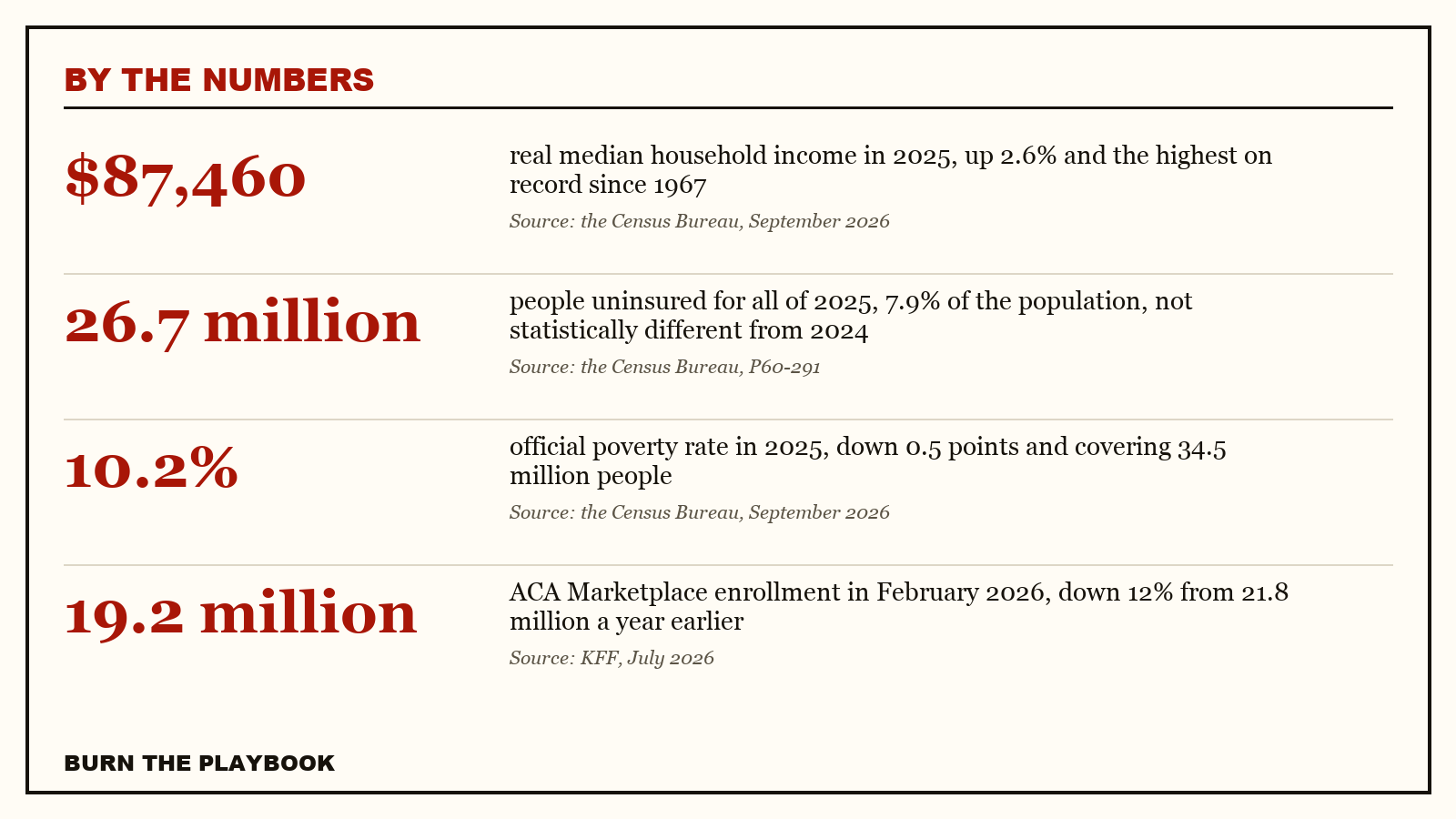
By the Numbers
$87,460: real median household income in 2025, up 2.6% and the highest on record since 1967, per the Census Bureau, September 2026
26.7 million: people uninsured for all of 2025, 7.9% of the population, not statistically different from 2024, per the Census Bureau, P60-291
10.2%: official poverty rate in 2025, down 0.5 points and covering 34.5 million people, per the Census Bureau, September 2026
19.2 million: ACA Marketplace enrollment in February 2026, down 12% from 21.8 million a year earlier, per KFF, July 2026
10 million: more people CBO projects will be uninsured in 2034 under the 2025 reconciliation law, 7.5 million of them because of the Medicaid changes, per the Congressional Budget Office
Ad. BTP earns a commission if you sign up.
If your 2026 paycheck is not keeping up. FinanceBuzz is advertising a card it says carries no annual fee, 0% intro APR into 2027, and up to a $250 travel bonus. The terms are FinanceBuzz's, so read them before you apply. See if you qualify →
Advertisement. An outside company paid for this spot. It keeps BTP free to read. BTP does not endorse the offering.
The best in influencer marketing. And you’re invited.

Get ready for Return on Influence Festival '26. An entire day dedicated to influencer marketing with speakers running some of the best programs in the world. October 21, 2026, 10 am - 5 pm ET.
The paycheck number is real.
I'll give the administration this one, because the data does. Median income rose 4.8% for Black households and 3.0% for white households, per the Census release, while Asian and Hispanic households showed no statistically significant change. Among full-time, year-round workers, women's median earnings rose 3.2% and the female-to-male earnings ratio climbed to 83.9% from 80.6%, per the Census income report. Child poverty hit what the Bureau calls "a historic low of 13.4%," and Hispanic poverty fell 1.2 points to a historic low of 13.9%.
University of Chicago economist Steven Durlauf called the income gain "nothing to sneeze at," Stateline reported. He's right. More money in a paycheck is rent and groceries, and nobody should try to talk a family out of it.
Treasury Secretary Scott Bessent made the administration's case the same day, before the House Financial Services Committee. "A new industrial supercycle is moving from investment into production, and from blueprints into paychecks," he said in prepared testimony quoted by the Washington Free Beacon. That is a political office selling a political record, and the income line hands it a real number to sell.
The half that did not improve.
The uninsured count did not budge: 26.7 million people, 7.9% of the country, per the Census health insurance report. The Supplemental Poverty Measure, which accounts for taxes and government benefits, sat at 13.1%, which Census says is not statistically different from 2024. Durlauf read that flat line as a sign that lower-income households relying on government benefits aren't really benefiting from "an economy that's running hot." Among adults 19 to 64, Medicaid coverage fell 0.6 points and public coverage fell to 17.3%.
The Census Bureau points to the pandemic unwinding, saying its effects "can be seen in the decrease in Medicaid coverage in 2024 and 2025." Continuous Medicaid enrollment ended March 31, 2023, per KFF. What this report cannot show yet is the federal work requirement, which becomes mandatory on January 1, 2027.
The survey stops at December 31. The bill kept coming.
Census asks about the previous calendar year, in interviews fielded from February through April, so this report is a picture of 2025. The enhanced premium tax credits expired when 2025 ended. By February 2026, ACA Marketplace enrollment had fallen to 19.2 million from 21.8 million a year earlier, a 12% drop that came as the credits expired, per KFF's July 2026 state-by-state enrollment analysis. Wednesday's issue covered what the lapse did to monthly premium payments, so I won't run it twice.
Then comes Medicaid. The reconciliation law President Trump signed on July 4, 2025, per the White House, sets an 80-hour monthly work requirement for adults in the Medicaid expansion group starting January 1, 2027, and lets states move sooner, per KFF. The Congressional Budget Office projects the law will leave 10 million more people uninsured in 2034, 7.5 million of them because of the Medicaid changes, and more than half of that Medicaid share traces to the work requirement.
Those are projections, not head counts, and projections miss. But the dates are written into law, and they tell you which reports will carry the bill. Next year's report covers 2026, the first year without the enhanced credits. The one after that covers 2027, the year the federal work requirement becomes mandatory.
Hold both numbers.
The income gain is real, and anyone who waves it away is arguing with the Census Bureau. The Marketplace drop and the Medicaid projections live after this report's calendar ends, and anyone holding up this report as proof they won't hurt is selling you a year that already ran out. Ask both parties the same question: what do you expect next year's uninsured number to be, and will you own it?
Forward this to one person who has heard about the $87,460 and deserves the rest of the report.
Paid recommendation. BTP may earn when you subscribe.
Five minutes, then back to your day. Five Minute Daily says it covers the whole day's news in five minutes. BTP goes deep on one story each issue, and Five Minute Daily covers the quick sweep of the rest. Try Five Minute Daily free →
Sources
U.S. Treasury, Secretary Bessent statement, September 15, 2026.
U.S. Census Bureau, on Medicaid coverage in 2024 and 2025, September 15, 2026.
U.S. Census Bureau, Income, Poverty and Health Insurance Coverage in the United States: 2025, September 15, 2026.
U.S. Census Bureau, Health Insurance Coverage in the United States: 2025 (P60-291), September 15, 2026.
U.S. Census Bureau, Income in the United States: 2025 (P60-289), September 15, 2026.
KFF, How Has ACA Marketplace Enrollment Changed Across States in 2026?, July 28, 2026.
KFF, A Closer Look at the Work Requirement Provisions in the 2025 Federal Budget Reconciliation Law, checked September 2026.
KFF, 10 Things to Know About the Unwinding of the Medicaid Continuous Enrollment Provision, checked September 2026.
Congressional Budget Office, Distributional Effects of Public Law 119-21, checked September 2026.
The White House, President Trump's One Big Beautiful Bill Is Now the Law, July 2025.
Stateline, Census Data Shows US Poverty Rate Drops to Lowest on Record, but Experts Are Cautious, September 15, 2026.
Washington Free Beacon, report on the Census release and Treasury Secretary Bessent's September 15 testimony, checked September 2026.
Burn Notice: Both parties are grading 2025. The coverage bill is dated 2026 and 2027.
Michael
This one is built to forward.
Drop your email and the next receipt lands where you can actually use it.
Already on the list? Send this to one person who reads the fine print.
New here? Subscribe from this issue so the dashboard can count the public funnel, not just imports.